
ZHUOZHU New Products Hub: Seize Opportunities in Thermal Insulation
In today’s increasingly competitive market environment, no industry can afford to lack a sharp insight into innovative products. The discovery of new products often signals the emergence of new business opportunities. Those who can quickly identify new product trends and plan ahead will be able to seize the initiative in competition and gain greater profit margins.
To this end, ZHUOZHU officially launches a new section dedicated to systematically organizing and continuously updating the latest products and innovative developments in the thermal insulation industry. We are committed to building an efficient and professional information platform that empowers professionals in the industry to stay informed about new product releases, understand market trends, and capitalize on growth opportunities.
In our R&D pipeline, in addition to the products already successfully developed (listed below), projects involving MGO-PIR and MGO-XPS composites will soon be launched. (Record date: January 12, 2026)
Metal Carved Insulation Panel

Product Name: Carved metal panels, metal carved panels, exterior wall insulation carved panels.
Launch Date: Mid-2024 (Estimated)
Key Advantage: Breaking the monotony of traditional sandwich panels, the rich relief textures and colors give the building facade a high appearance.
Consideration: To preserve the decorative effect, the panel thickness is limited, which means its standalone insulation performance is best suited for specific climates.
Primary Application: Ideally used for enhancing the exterior aesthetics and thermal insulation of residential and commercial buildings.
Description:
In regions with mild winters, it provides sufficient insulation on its own. In environments with significant temperature variations (e.g., northern climates), it serves excellently as the outer decorative layer of a composite insulation system, working in tandem with the primary inner insulation material (such as insulation within wood-frame walls) to achieve both beauty and energy efficiency.
Great Wall Insulated Panels

Product Name: Aluminum Sandwich Panel, Great Wall Aluminum Panel, Great Wall Insulation Panel
Key Advantage: The numerous raised grates facilitate drainage, making it more suitable for residential applications. Aluminum is more corrosion-resistant and lightweight.
Consideration: Polyurethane offers excellent insulation, even without requiring a thick layer.
Primary Application: Ideal for enhancing the aesthetics and thermal performance of residential and commercial roofs.
Description:
It can meet the thermal insulation requirements of any region, and its lightweight design means it will not burden the building’s load-bearing capacity.
PVC EPS Sandwich Roof Panel

- Key Advantage: The solid PVC surface ensures outstanding waterproofing and durability, while the EPS core provides efficient thermal insulation. The panel is lightweight, easy to install, and offers optional base layers (PVC or aluminum foil) to suit different moisture and reflective needs.
- Consideration: EPS delivers reliable thermal performance with a slim profile, making it a cost-effective solution for energy-efficient roof systems.
- Primary Application: Perfect for upgrading the thermal insulation and weather resistance of residential, industrial, and commercial roofing structures.
Description:
This panel is designed to meet thermal insulation standards across various climates. Its lightweight construction minimizes additional load on the building, while the robust PVC surface and adaptable bottom layer ensure long-term performance in diverse environmental conditions.
PIR (Polyisocyanurate) and Aluminum Foil

- Key Advantages: Superior thermal insulation and dual-barrier protection. PIR boasts the lowest thermal conductivity among commercially available insulation materials, delivering exceptional thermal performance with minimal thickness while offering inherent Class B1 fire resistance. When combined with an outer aluminum foil layer, it efficiently reflects over 90% of radiant heat and creates a 100% moisture-proof barrier, ensuring long-term system stability.
- Considerations: Higher costs and specific installation requirements. The initial procurement cost is higher than that of traditional insulation materials. As PIR is somewhat brittle, care must be taken to prevent impact damage during transport and installation. Additionally, since the aluminum foil is highly conductive, failure to tightly seal joints with specialized tape can easily create thermal bridges (or “cold bridges”), leading to localized heat loss or condensation.
Description:
High-efficiency reflective composite insulation board. This product is a lightweight panel featuring a high-performance polyisocyanurate (PIR) foam core sandwiched between aluminum foil facings. It retains heat through a dual mechanism of blocking conduction and reflecting radiation. Widely used in high-end central air conditioning ductwork, ultra-low energy building envelopes (roofs and walls), and cold storage insulation, it is an ideal choice for projects prioritizing long-term energy efficiency and safety.
PIR (Polyisocyanurate) Underfloor Heating Panels

- Key Advantages: No backfilling required; features high reflectivity and rapid modular installation. The panel surface is precision-milled with grooves for hydronic piping and fully clad in aluminum foil, allowing pipes to be embedded directly. This design eliminates the labor-intensive “cement and pea-gravel backfilling” process typical of traditional wet underfloor heating, significantly reducing floor load and preserving ceiling height. The aluminum foil lining the grooves creates a tight, 3D wrap that ensures heat radiates directly and evenly upwards; this results in room heating speeds several times faster than traditional systems and delivers exceptional energy efficiency.
- Considerations: Demands high standards for floor flatness and piping layout flexibility. Unlike cement backfilling, which inherently levels the floor, dry underfloor heating panels require an absolutely flat subfloor; otherwise, the finished flooring may develop hollow spots or squeaking noises. Furthermore, because the grooves are factory-set (e.g., fixed-spacing Omega-shaped channels), piping must strictly follow the module’s layout path, preventing the on-site adjustments to spacing or curvature often possible with traditional installation methods.
Description:
Prefabricated grooved PIR insulation panel for dry underfloor heating. This is a smart composite panel designed specifically for high-efficiency dry hydronic underfloor heating. It features a high-density polyisocyanurate (PIR) core for insulation, a surface precision-molded with dedicated grooves for piping, and a full lamination of highly reflective aluminum foil. Integrating insulation, heat reflection, and pipe securing into a single unit, the system allows for direct installation of wood flooring after simply interlocking the modules and inserting the pipes. It is an ideal choice for modern lightweight construction, heating upgrades in older buildings, and projects prioritizing rapid heating performance.
Graphene-Enhanced EPS and Granite

- Key Advantages: Superior thermal insulation, Class A/B1 fire resistance, and efficient prefabricated installation. The incorporation of graphene nanomaterials significantly lowers the thermal conductivity of the EPS, boosting insulation performance by approximately 30%; the graphene-based nano-fire barrier imparts excellent flame retardancy, overcoming the flammability issues associated with traditional foam exterior insulation. High-end stone facings, factory-bonded to the surface, provide the building with exceptional weather resistance and a luxurious aesthetic, while eliminating the heavy steel framework loads required for traditional dry-hung stone systems and reducing construction time by over 50%.
- Considerations: Stringent requirements for interface bonding safety (to prevent delamination), substrate flatness, and joint sealing. Due to the differing thermal expansion coefficients between the organic insulation layer and the heavy inorganic stone, there is a risk of localized delamination under long-term temperature fluctuations and wind loads, necessitating reinforced mechanical anchoring. The large panel dimensions leave little margin for error regarding the flatness and verticality of the main wall structure; furthermore, the durability of the weather-resistant sealant in the joints is critical—aging or water leakage can lead to freeze-thaw damage during winter.
Description:
Graphene-EPS Stone-Faced Integrated Insulation and Decoration Panel. This is a modern, prefabricated green building panel that integrates superior thermal insulation, fire safety, and a high-end finish. The product features a core of dark-grey, high-density graphene-modified EPS with a rigid outer layer of natural or simulated stone, all bonded together through an integrated factory production line. Utilizing an industrial approach of “factory prefabrication combined with on-site bonding and anchoring,” it serves as an ideal alternative to traditional dry-hung stone and separate external insulation methods, making it perfect for mid-to-high-end public buildings, residential facades, and energy-efficiency retrofits for older housing complexes.
Phenolic Foam and Aluminum Foil

- Key Advantages: Fire safety with zero toxic smoke, superior thermal insulation, and moisture-proof reflectivity. The primary competitive advantage of phenolic foam lies in its unparalleled fire safety; it typically meets Class A non-combustibility standards, does not melt or drip when exposed to high-temperature fire, does not propagate flames, and generates virtually no toxic smoke. It boasts an extremely low thermal conductivity (approximately $0.020 \text{ W/(m·K)}$), offering insulation performance superior to PIR and polyurethane. When combined with double-sided aluminum foil, it blocks over 90% of radiant heat and creates an absolute moisture-proof vapor barrier.
- Considerations: Brittleness, residual strong acids, and high costs. As a thermosetting material, phenolic foam is more brittle than PIR; it is highly susceptible to edge crumbling, dusting, or fracturing during transport and installation, and exhibits poor impact resistance. Additionally, if acidic catalysts are improperly formulated during the production of early-generation or low-end phenolic foam, trace amounts of strong acid may remain. In humid environments, this can cause chemical corrosion—known as “phenolic corrosion”—on the bonded aluminum foil or adjacent metal piping. Its initial procurement cost is also significantly higher than that of standard foam materials.
Description:
Ultra-high fire-rated composite insulation board (fire-resistant air ducts/insulation panels). This is a lightweight composite board featuring a phenolic foam core with a high closed-cell ratio, precision-bonded between two layers of rigid or embossed aluminum foil. Defined by its “Class A fire rating, ultra-low thermal conductivity, and zero toxic smoke” characteristics, the material carbonizes upon exposure to fire, forming a robust, fire-resistant protective layer. The product is widely used in central air conditioning duct systems for large public facilities—such as hospitals, airports, and subways—where fire safety and environmental standards are stringent, as well as in high-end internal wall insulation projects.
EPS and Granite
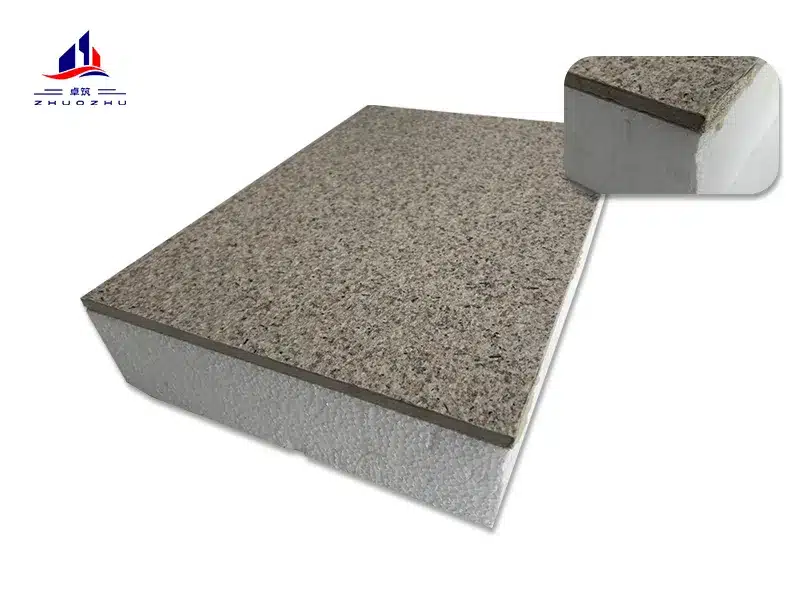
Low price / Affordable
Bonding plain white EPS directly to granite panels offers only one advantage: a low price.
