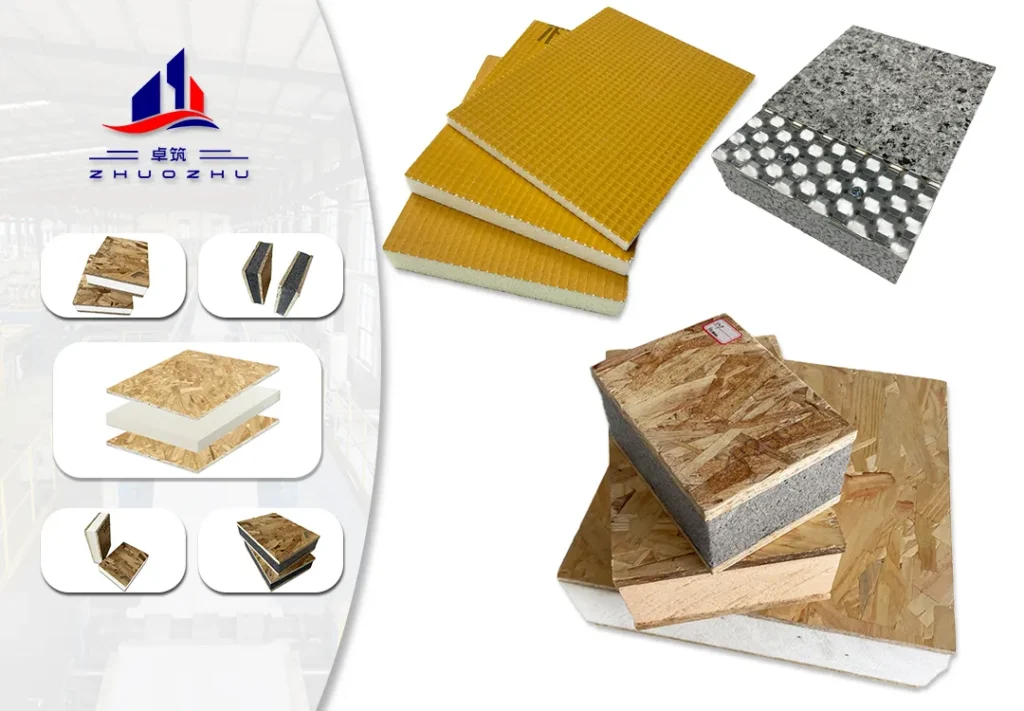
XPS OSB SIPs
XPS OSB SIPs
This product is mainly used for the insulation of exterior walls of buildings such as steel-structured villas and cannot be used in cold rooms and clean rooms.
LEADING TRADITIONAL XPS OSB SIPs MANUFACTURER & SUPPLIER IN CHINA
As a leading manufacturer and supplier in China, we specialize in producing integrated XPS-OSB Structural Insulated Panels (SIPs). This innovative composite panel features a rigid XPS foam core permanently bonded between two oriented strand board (OSB) facings, creating a high-performance building solution that combines exceptional thermal insulation with remarkable structural strength in a single, ready-to-install product.
About ZHUOZHU XPS OSB SIPs
XPS Insulation Panels
XPS OSB SIPs
SIPs panels, which use XPS as the insulation core material and OSB as the structural surface layer, combine excellent insulation, strong load-bearing capacity and fast construction.
- Superior Insulation. Simplified.
- The Ultimate Barrier. The Ultimate Efficiency.
- Engineered for Extreme Performance.
- Efficiency, Redefined.
- The Smart Way to Build.
CONTACT US
Address:
Office: Global International, Lanshan District, Linyi City, Shandong Province, China
Three Types of OSB SIPs (XPS, EPS, and Polyurethane)
| Property | XPS (Extruded Polystyrene) | EPS (Expanded Polystyrene) | Polyurethane (PU/PIR) |
|---|---|---|---|
| Insulation Performance (R-value/in) | Good (Approx. R-5) | Fair (Approx. R-3.6 to R-4) | Excellent (Approx. R-6 to R-7) |
| Closed-Cell Structure & Moisture Resistance | Excellent (Tight closed-cell, high water resistance) | Moderate (Micro gaps present, can absorb moisture) | Exceptional (Dense closed-cell, extremely high water resistance) |
| Compressive Strength | Excellent (High strength, good load-bearing) | Moderate (Strength depends on density) | Excellent (High strength, good load-bearing) |
| Fire Performance | Moderate (Requires flame retardants) | Moderate (Requires flame retardants) | Good-Excellent (Particularly PIR, better inherent fire resistance) |
| Cost Comparison | Medium-High | Low (Most cost-effective) | High |
| Key Advantages | High strength, superior moisture resistance, stable insulation | Low cost, established application, reliable performance | Superior insulation efficiency, high strength, excellent vapor barrier |
| Potential Drawbacks | Higher cost, debatable environmental footprint | Lower insulation efficiency, requires greater thickness, can absorb moisture | Highest cost, may decompose at high temperatures |
High Compressive Strength and Structural Stability
The rigid closed-cell structure gives the panel high compressive strength, enabling it to withstand various loads during construction and use without deformation, ensuring panel flatness and structural integrity.
Lightweight yet Strong for Efficient Installation
While ensuring strength, XPS is lightweight, easy to cut and install. This significantly improves installation efficiency, shortens project timelines, and reduces labor costs.
Environmentally Safe and Cost-Effective
No harmful substances are used in the production process, and it is free from odors or harmful emissions during use. Its superior energy-saving performance delivers significant economic and environmental benefits throughout the building’s lifecycle.
Superior Moisture and Vapor Resistance
The board is virtually non-absorbent and has high resistance to water vapor transmission, effectively blocking moisture ingress. This prevents internal condensation and mold growth, making it ideal for rainy and humid climates.
High Durability and Long Service Life
Excellent resistance to moisture, corrosion, and aging allows XPS insulated wall panels to maintain long-term performance stability, matching the building’s lifespan and minimizing future maintenance and replacement costs.
Exceptional and Long-Lasting Thermal Performance
XPS provides a stable high R-value. Its tight closed-cell structure ensures the insulation performance does not degrade over time, effectively reducing building energy consumption.
A Comprehensive Guide to XPS Insulation Boards: Pros, Cons, Comparisons and Applications
In the field of modern building energy efficiency, XPS (Extruded Polystyrene) insulation boards have become one of the most widely used high-performance thermal insulation materials due to their exceptional properties. Whether used in walls, roofs, or floors, XPS plays a crucial role. This article provides an in-depth analysis of the advantages and disadvantages of XPS, its comparison with other common insulation materials, and its core application areas.
1. What is XPS?
XPS, or Extruded Polystyrene, is a rigid foam board manufactured from polystyrene resin and additives through a process of heating and extrusion molding. Its internal structure consists of continuous, uniform closed-cell honeycombs, a unique manufacturing process that gives it outstanding performance characteristics.
2. Core Advantages of XPS
Excellent Thermal Performance (High R-value)
XPS boasts a thermal resistance of up to R-5 per inch, far exceeding that of traditional EPS (expanded polystyrene). Its closed-cell structure effectively blocks heat flow, ensuring stable internal building temperatures and significantly reducing heating and cooling energy consumption.Superior Moisture and Vapor Resistance
This is one of XPS’s most prominent advantages. Its tight closed-cell structure is virtually non-absorbent and offers high resistance to water vapor transmission. Even in prolonged damp conditions, it remains dry and maintains stable insulating performance, effectively preventing internal condensation and mold growth.High Compressive Strength
The manufacturing process gives XPS very high compressive strength, typically ranging from 150 kPa to over 700 kPa. This makes it ideally suited for applications subject to high loads, such as under parking decks, airport runways, roof terraces, and foundation insulation.Lightweight yet Strong, Easy Installation
Despite its strength, XPS is lightweight, making it easy to transport, cut, and install. This significantly improves construction efficiency and reduces labor costs.Durability and Dimensional Stability
XPS boards offer good resistance to aging and excellent dimensional stability. They are resistant to deformation, shrinkage, or expansion over time, capable of lasting the lifetime of the building and reducing long-term maintenance issues.
3. Potential Disadvantages of XPS
Relatively Higher Cost
Compared to traditional EPS, the production cost and market price of XPS are generally higher.Environmental Concerns
Some traditional XPS manufacturing processes may use HCFC blowing agents, which have potential ozone depletion potential. However, many leading manufacturers have now transitioned to more environmentally friendly CO₂ blowing technologies.Fire Performance Requires Enhancement
Like most organic insulation materials, XPS is combustible and requires the addition of flame retardants to achieve fire ratings such as Class B1 or B2. Fire safety precautions during construction are important.
4. Comparison: XPS vs. EPS vs. Polyurethane
| Characteristic | XPS | EPS | Polyurethane |
|---|---|---|---|
| Thermal Performance (R-value/in) | Good (Approx. R-5) | Fair (Approx. R-4) | Excellent (Approx. R-6 ~ R-7) |
| Moisture/Vapor Resistance | Excellent | Fair (can absorb moisture) | Excellent |
| Compressive Strength | High | Moderate (depends on density) | High |
| Cost | Medium-High | Low | High |
Summary:
EPS is the economical choice for cost-driven projects.
XPS offers the best balance of performance, moisture resistance, and cost, making it the preferred choice for most demanding applications.
Polyurethane is the premier choice for pursuing ultimate energy efficiency and performance, but at a higher price.
5. Main Application Areas of XPS
Leveraging its combined advantages of moisture resistance, compressive strength, and insulation, XPS is widely used in:
Building Wall Insulation Systems
Used as the insulation layer in External Thermal Insulation Composite Systems (ETICS) or as cavity wall insulation.Roof and Terrace Insulation
Used in inverted roofs, green roofs, and for insulation and leveling under parking decks, plazas, etc., where its compressive strength is critical.Frost-Protected Shallow Foundations
Installed beneath building foundations or frost-susceptible roadbeds to effectively prevent ground cracking or heaving due to freeze-thaw cycles.Cold Storage and Specialized Engineering
Its excellent moisture resistance makes it ideal for insulating cold storage facilities, refrigerated trucks, and other low-temperature, high-humidity environments.Composite Wall Panels (SIPs)
Used as the insulating core material in Structural Insulated Panels (SIPs), bonded to OSB (Oriented Strand Board) for rapidly constructed, energy-efficient buildings.
Conclusion
XPS extruded boards, with their combined advantages of high thermal efficiency, exceptional moisture resistance, and high compressive strength, have secured an irreplaceable position in modern construction. Despite considerations regarding cost and environmental impact, their long-term performance and durability make them a wise investment for projects pursuing high quality and energy efficiency. When selecting, it is advisable to weigh XPS against materials like EPS and polyurethane based on the specific application, budget, and performance requirements.
Product Center
Discover our comprehensive range of thermal insulation materials, including 5 main series and over 30 product finishes, designed to meet the thermal insulation needs of modern buildings.
Metal Sandwich Panels
Polyurethane(PUR/PIR)/Rockwool/EPS/Polyurethane Edge Banding/Solar Energy
OSB SIPs
OSB and polyurethane (or EPS) sandwich, cut and shipped according to your drawings.
Cold Room Panels
Short-term Storage (0°C to +4°C) / Frozen Storage (-18°C to -25°C) / Quick Freezing (-35°C to -40°C)
Clean Room Panels
Silica Rock/Fireproof EPS/Glass Magnesium/Magnesium Oxysulfate
Metal Carved Panels
Wood Grain/Stone Grain/Brick Grain/Embossed/Stone Coating
Need any help with projects?
A multifaceted professional skilled in multiple fields of research, development as well as a learning specialist. Over 15 years of experience.
Room 1304, Building A, Global International, Lanshan District, Linyi City, Shandong Province, China
1141, Industrial Park, Luozhuang District, Linyi City, Shandong Province
ZHUOZHU Blog
We aim to be your reliable information partner, consistently sharing practical blog articles, timely industry updates, and forward-looking new product information. With thoughtful content, we will accompany every step of your growth in the thermal insulation materials industry.
Deciphering Rock Wool vs. PIR Sandwich…
In modern architectural design and construction, insulation and fire resistance have become core metrics for evaluating the quality…
SIPs (Structural Insulated Panels) Market Classification…
Introduction: A New Understanding of Structural Insulated Panels SIPs (Structural Insulated Panels) have evolved from an innovative building…
SIPS Building Systems: Revolutionizing Construction with…
Introduction: The Future of Building Technology SIPS building systems represent a transformative approach to modern construction, integrating structural…