
Introduction: A New Understanding of Structural Insulated Panels
SIPs (Structural Insulated Panels) have evolved from an innovative building material into a core component of modern, high-efficiency building systems. Their essence lies in integrating structural strength and thermal insulation within factory-prefabricated composite panels. The diversity of SIPs products on the market stems from the rich combination possibilities of facing materials and core materials, much like the bread and filling of a “sandwich.” This article systematically outlines the current mainstream facing and core material options and analyzes their combination logic to provide a clear guide for selecting the most suitable SIPs solution for your project needs.
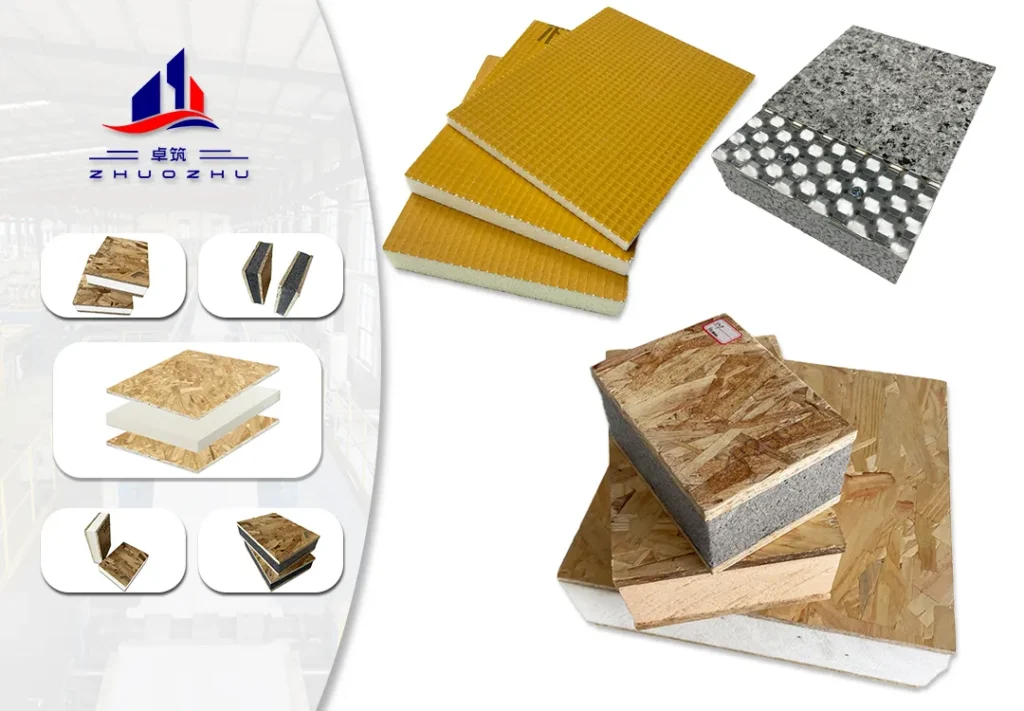
Part I: Facing Material Options – The Building’s “Skin” and Skeleton
The facing material is the structural load-bearing layer of SIPs, determining their mechanical properties, fire rating, weather resistance, and final appearance.

- OSB (Oriented Strand Board)
- Characteristics: Cost-effective, high strength, good nail-holding capacity, easy to connect with wood framing.
- Applications: The most mainstream choice, widely used for walls, roofs, and floors in residential and low-rise commercial buildings.
- Key Considerations: Moisture protection is crucial, requiring ensured edge sealing and proper vapor barrier design.
- Gypsum Board
- Characteristics: Excellent fire performance (as a fire-resistant surface layer), smooth and flat, can serve directly as an interior finish substrate.
- Applications: Commonly used for interior partition walls and ceiling systems with special fire requirements, or as a fire-resistant/finish layer on the interior side of OSB panels.
- Key Considerations: Lower structural strength, typically not used alone as the primary load-bearing facing material.
- MGO Board (Magnesium Oxide Board)
- Characteristics: Class A non-combustible, moisture-resistant, mold-resistant, high strength, environmentally friendly (formaldehyde-free).
- Applications: Spaces with high requirements for fire resistance, moisture resistance, and hygiene, such as hospitals, laboratories, kitchens, bathrooms, and high-end residences.
- Key Considerations: Quality varies significantly; selecting brands with high stability is essential.
- Calcium Carbonate Board
- Characteristics: Fire-resistant, moisture-resistant, corrosion-resistant, hard texture, good dimensional stability.
- Applications: Exterior wall sheathing, substrate for wet areas, fire-rated partition walls.
- Cement Fiberboard
- Characteristics: Completely non-combustible, excellent durability, impact-resistant, pest-resistant, suitable for harsh environments.
- Applications: Building exterior cladding (can be combined with decorative layers), roof decking, industrial building envelopes.
- Metal Panel (Steel/Aluminum)
- Characteristics: Highest strength, excellent durability, can be pre-finished in various colors and textures (e.g., PVDF coating), rapid installation.
- Applications: Roofing and wall systems for industrial plants, logistics warehouses, and large commercial buildings, creating a fast-enclosing system that integrates structure, insulation, and decoration.

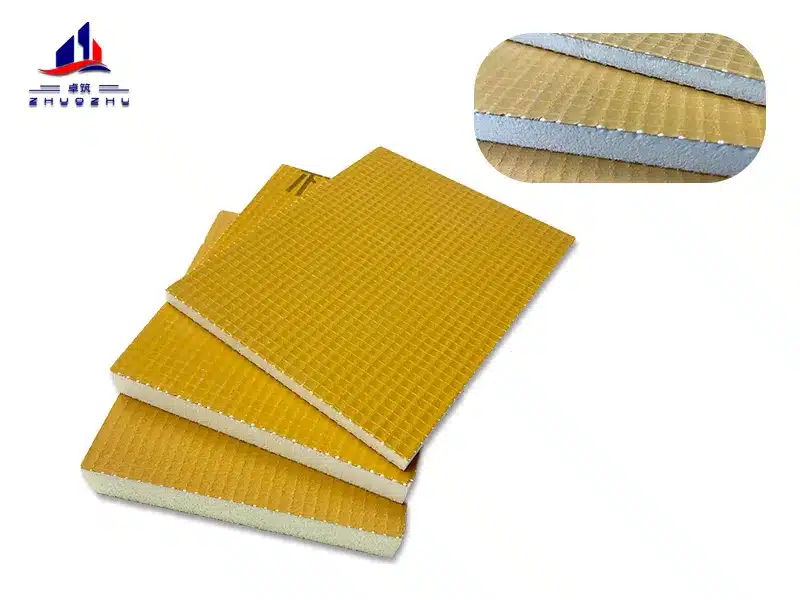
Part II: Core Material Options – The Building’s “Thermal Underwear”
The core material is the thermal insulation heart of SIPs, directly determining a building’s energy efficiency, panel thickness, and long-term reliability.
- Phenolic Resin
- Characteristics: Exceptional fire performance (can achieve Class A/Non-combustible), low smoke and toxicity, good high-temperature stability. Insulation performance is better than rock wool but slightly inferior to PIR.
- Advantages: Outstanding safety and environmental profile; a top choice for public buildings and high-rises with stringent fire requirements.
- Note: Higher cost, relatively more brittle.
- EPS (Expanded Polystyrene)
- Characteristics: Most economical, lightweight, good moisture resistance, mature technology. Thermal performance (R-value ~R4 per inch) meets most basic requirements.
- Advantages: The king of cost-effectiveness; the most common choice for mainstream residential SIPs projects.
- Note: Requires flame-retardant type; may experience slight creep under long-term compression.
- Graphene-Enhanced EPS
- Characteristics: Traditional EPS infused with graphite particles, improving thermal performance by 15-20% through reflection of radiant heat.
- Advantages: Achieves higher R-value (approx. R4.5-5 per inch) at a similar cost, an excellent choice for energy efficiency upgrades.
- Note: Still falls under the EPS category; same fire performance.
- XPS (Extruded Polystyrene)
- Characteristics: Denser closed-cell structure, high strength, excellent moisture resistance, stable long-term thermal performance. R-value ~R5 per inch.
- Advantages: Suitable for floor panels, basements, roofs, and other areas requiring high compressive strength and moisture resistance.
- Note: Cost higher than EPS; environmental choices need consideration.
- PIR (Polyisocyanurate)
- Characteristics: The performance leader in insulation (R-value up to R6.5-7 per inch), excellent fire performance (Class B1 flame-retardant), dimensionally stable.
- Advantages: The undisputed best choice when pursuing ultra-low energy consumption, Passive House standards, or when thickness is constrained. Also the core material for ZHUOZHU’s high-end cold room systems.
- Note: Highest cost, but the long-term energy savings and space savings brought about by the superior performance can offset the initial investment.
- Cement-EPS Composite Core
- Characteristics: A composite core formed by combining EPS beads with cementitious materials, offering some structural rigidity and Class A fire resistance.
- Advantages: Combines insulation and fire resistance, particularly suitable for prefabricated building walls with mandatory fire requirements.
- Note: Thermal insulation performance is typically lower than that of pure polymer foam cores.

Part III: Combination Logic and Application Scenarios – How to Assemble the “Perfect Sandwich”
The combination of facing and core materials is not arbitrary; it follows principles of complementary performance, economic suitability, and code compliance.
Classic High-Performance Combinations
- OSB + PIR Core
- Scenario: Ultra-low energy homes, Passive Houses, high-end custom residences.
- Logic: OSB provides excellent bending and shear strength, PIR provides top-tier insulation. This combination achieves extremely high insulation requirements with thinner walls, making it the performance-oriented gold standard.
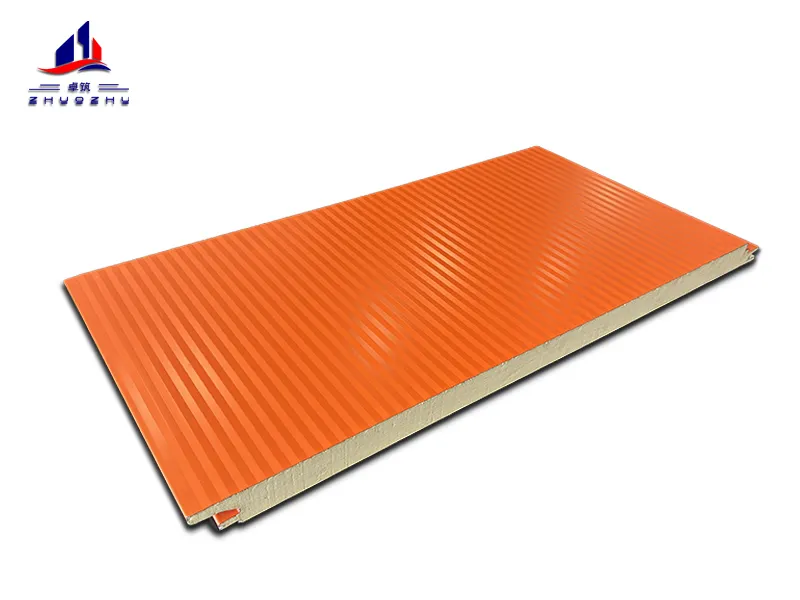
- Metal Panel + PIR/PUR Core
- Scenario: Industrial plants, cold chain logistics centers (cold rooms), large commercial buildings.
- Logic: The metal facing provides a durable, low-maintenance exterior shell and fast installation features. The PIR/PUR core ensures thermal efficiency and energy cost control under large temperature differentials (especially in freezer rooms). This is the core solution for ZHUOZHU in the industrial and cold chain sectors.
- Cement Fiberboard/MGO Board + Phenolic Core
- Scenario: Schools, hospitals, high-rise building facades, areas with special fire compartmentation requirements.
- Logic: Non-combustible facing + non-combustible/difficult-to-ignite core creates a comprehensive fire barrier from inside out, meeting the strictest building fire codes.
High Value-for-Money Combinations
- OSB + Graphene-Enhanced EPS / EPS Core
- Scenario: Mainstream residential projects, townhouses, small commercial buildings.
- Logic: Controls costs while ensuring structure through OSB and enhancing energy efficiency with Graphene EPS or meeting basic needs with standard EPS, achieving excellent value for money.
Special-Purpose Combinations
- Gypsum Board + EPS Core (for interior non-load-bearing partitions)
- Scenario: Rapid interior partitioning.
- Logic: Gypsum board provides a smooth, fire-resistant finish surface; EPS provides lightweight insulation and soundproofing, enabling quick installation.
Conclusion: A Systems Thinking Approach to Selecting SIPs
Choosing SIPs is not merely about selecting a panel; it is about selecting a complete wall or roof system that integrates structure, insulation, and building physics.
- Start with Requirements: First, clarify the project’s energy efficiency standards (e.g., net-zero, Passive House), fire rating, structural spans, budget, and desired architectural finish.
- Excel in Matching: Based on the requirements, select the appropriate facing and core material combination from the “menu” above. For example, building a -25°C freezer room makes the metal facing + thick PIR core combination almost the default choice.
- Succeed with Details: Connection details, airtightness treatment, moisture control design, and interfaces with foundations and other building components are as crucial as the panels themselves.
- Trust Professionals: Partnering with a supplier like ZHUOZHU, which possesses a comprehensive product line (from
OSB SIPstometal sandwich panelsandcold room systems) and global project experience, provides full technical support from thermal calculations and structural verification to detail design, ensuring your chosen “perfect sandwich” performs flawlessly in the project.
By understanding the classification and combination logic of SIPs, you will be able to move beyond comparing single products and approach your building’s envelope with a systems perspective to create an efficient, safe, and economical structure.
