
Introduction: The Strategic Choice Where Temperature Decides Everything
In industries requiring precise temperature control, such as food, pharmaceuticals, and chemicals, selecting the correct cold room type is not merely a matter of setting a temperature. It is a strategic decision that impacts product safety, operational costs, and technical feasibility. Although both refrigerated rooms and frozen storage rooms belong to the category of low-temperature environments, they differ fundamentally in design philosophy, core configuration, and operational logic. As a professional manufacturer providing complete cold room system solutions, ZHUOZHU will provide an in-depth analysis of the selection rationale and configuration essentials for these two core temperature-controlled environments.
Dimension One: Core Temperature Ranges and Functional Definitions
Refrigerated Rooms: The “Pause Button” for Life

- Standard Temperature Range: +0°C to +10°C (The optimal range is typically +2°C to +8°C)
- Core Functions:
- Inhibit Microbial Activity: Significantly reduce the reproduction rate of bacteria, mold, and yeast.
- Delay Biochemical Reactions: Slow down respiration in fruits and vegetables, enzymatic browning, and nutrient loss.
- Maintain Product State: Preserve the original physical state of products (e.g., liquid, softness) without ice crystal formation.
- Typical Applications:
- Short-term preservation and ripening of fresh fruits and vegetables
- Storage of dairy products (milk, yogurt, cheese)
- Beverages, eggs, and some processed foods
- Constant-temperature storage of pharmaceuticals and vaccines (2-8°C)
- Preservation of flowers and seeds
Frozen Storage Rooms: The “Freezer” of Time
- Standard Temperature Ranges:
- Conventional Freezing: -18°C (International standard)
- Deep Freezing: -25°C to -30°C (for ice cream, premium seafood)
- Blast/Quick Freezing: -35°C to -40°C or lower (for rapidly passing through the maximum ice crystal formation zone)
- Core Functions:
- Halt Microbial Activity: The growth of most microorganisms and enzyme activity are completely inhibited.
- Solid-State Water Lock: Convert most of the moisture in products into ice crystals, enabling long-term preservation.
- Long-Term Stability: Theoretically enables quality preservation for months or even years.
- Typical Applications:
- Long-term storage of meat, poultry, and aquatic products
- Frozen fruits & vegetables, prepared meals, ice cream
- Ultra-low temperature storage of some biological samples and reagents
- Low-temperature processing of special industrial raw materials
Dimension Two: Core Differences in System Configuration
Building Envelope: The “Battle of Thickness” for the Thermal Barrier
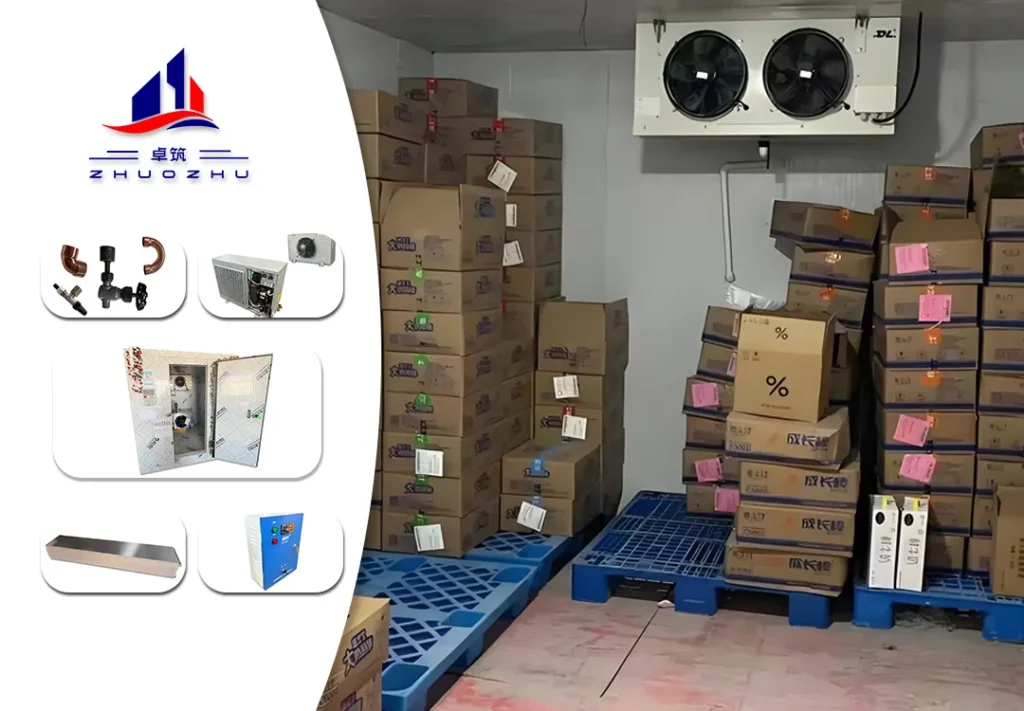
Refrigerated Rooms:
- Panel Thickness: Typically uses 100mm – 150mm
PUR/PIR sandwich panels. - Insulation Core: High-density polyurethane with thermal conductivity ≤ 0.024 W/(m·K).
- Design Focus: While ensuring insulation, emphasis must be placed on condensation prevention design and humidity control to prevent water condensation on interior walls.
Frozen Storage Rooms:
- Panel Thickness: Must use 150mm – 200mm or thicker
PUR/PIR sandwich panels. - Insulation Core: Ultra-high density, low thermal conductivity polyurethane or
PIRcore material to handle greater internal-external temperature differentials. - Design Focus: Absolute airtightness and thermal bridge-free design are critical. Must employ precision interlocking connection systems and special low-temperature sealants to eliminate any cold air leakage and local frost formation.
Refrigeration System: The “Different Heartbeats” of the Core
Refrigerated Rooms:
- Unit Selection: Medium-temperature refrigeration units, with evaporating temperatures typically between -10°C and 0°C.
- Air Distribution: Focuses on temperature uniformity and humidity retention. Often uses low air velocity, large-area distribution methods to avoid product dehydration.
- Defrost Control: Defrost cycles are relatively long and less frequent.
Frozen Storage Rooms:
- Unit Selection: Low-temperature refrigeration units, with evaporating temperatures as low as -40°C or below. Requires extremely high performance from core components like compressors and expansion valves.
- Air Distribution: Requires forced convection to ensure all areas of the room quickly reach and maintain ultra-low temperatures. Air velocity and airflow organization design are more complex.
- Defrost Control: Frequent defrosting requirements require efficient, intelligent hot gas defrost or electric defrost systems, with precise control over defrost timing and frequency to minimize temperature fluctuations.
Other Key Configurations
- Floor System: Frozen storage rooms must consider frost-heave protected flooring and heating systems to prevent ground freezing and upheaval from damaging the structure.
- Doors & Air Curtains: Doors for frozen storage rooms require higher insulation and airtightness performance and should be standard with high-efficiency air curtains to reduce cold loss when doors are open.
- Control System: Control systems for frozen storage rooms need to be more sophisticated, featuring multi-stage defrost, fault alarms, remote monitoring, etc.
Decision Flowchart: How to Make the Right Choice for Your Project
The Value of ZHUOZHU’s Integrated Solutions
Choosing ZHUOZHU means you receive not just optimal panels, but a complete system guarantee tailored for refrigeration or freezing needs.
- Precise Thermal Calculations: Our engineers will calculate and recommend the optimal panel thickness and cooling load based on your location, target temperature, door opening frequency, and other parameters, avoiding both “under-configuration” and “over-investment.”
- System Compatibility: The
PUR/PIR sandwich panelswe provide are highly compatible with and have extensive matching experience with mainstream refrigeration unit brands in the market, ensuring efficient synergy between the building envelope and the “refrigeration heart.” - Long-Term Cost Control: The correct initial configuration is the cornerstone of energy efficiency. A frozen storage room designed for a -25°C environment, if configured for refrigeration, would cause the refrigeration unit to operate continuously under high load, leading to staggering electricity bills. Our solutions aim to optimize total lifecycle cost.
- Global Project Experience: As a Chinese manufacturer serving the global market, we have accumulated rich experience in responding to different climates and industry standards, enabling us to provide best practices compliant with local regulations for your project.
Conclusion: The Intersection of Science and Commerce
The choice between Refrigeration and Freezing lies at the intersection of food science, thermodynamics, and business operations. There is no “better” system, only a “more suitable” configuration.
- When your goal is “Preservation,” choose a Refrigerated Room, focusing on temperature stability and humidity.
- When your goal is “Long-term Storage,” choose a Frozen Storage Room, investing in extreme insulation and refrigeration capacity.
Before making a final decision, the wisest step is to engage in in-depth consultation with a system solution provider like ZHUOZHU. Let us use our professional knowledge to help you make the most solid and efficient investment on this temperature-determined path.
