
Sandwich panels are precision-engineered building components. Their flat surfaces, smooth facings, and precise edge geometries are essential for achieving proper insulation performance, air tightness, and aesthetic appearance. However, during international transportation – from factory loading to sea freight and final unloading – panels face multiple risks of impact, friction, and deformation.
ZHUOZHU, as a professional manufacturer and global supplier of PIR/PUR, rock wool, EPS, cold room, and cleanroom panels, has encountered cases where customers chose not to use pallets during shipment. The result: scratched facings, bent edges, crushed cores, and functional damage. While ZHUOZHU always honors its responsibility and provides reasonable compensation, the best approach is preventive – proper palletization.

This article explains why wooden or steel pallets are non-negotiable for safe sandwich panel transport, and how ZHUOZHU supports customers with damage policies while advocating best practices.
1. Why Pallet-Free Loading Leads to Damage
When sandwich panels are loaded without pallets, they are typically stacked directly on the container floor or bundled only with straps. The following problems occur:
- Friction damage: During truck or vessel vibration, panels slide against each other, wearing off the protective film and scratching the metal facings (PVDF, polyester, or embossed coatings).
- Edge crushing: The weight of upper panels concentrates on the lower panel edges, causing core compression (especially for PIR and EPS) and loss of dimensional accuracy.
- Moisture ingress: Broken facings or damaged seals allow water vapor penetration, degrading thermal performance and promoting corrosion.
- Unloading hazards: Forklifts cannot safely lift un-palletized stacks, leading to dropped panels or prying damage.
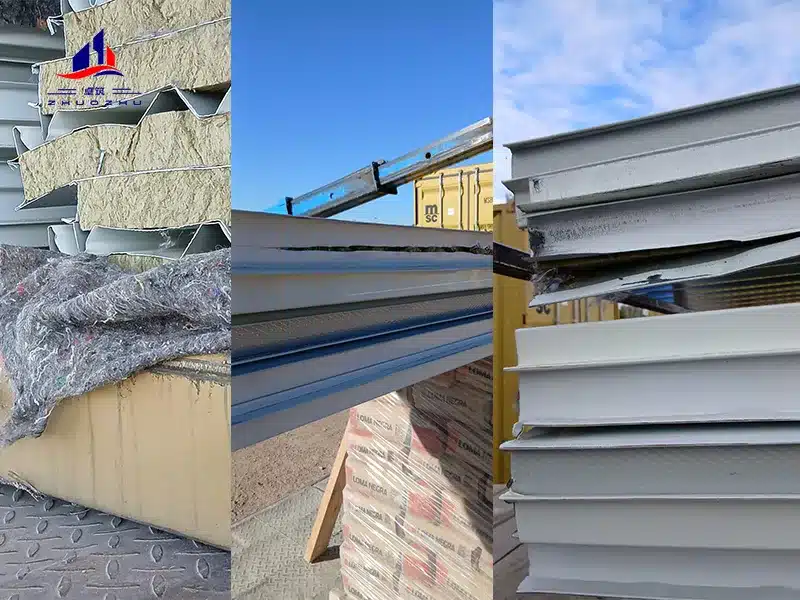
A customer of ZHUOZHU Company reported that more than 5% of the rock wool sandwich panels in a 40-foot container that arrived without pallets had obvious edge damage – we are actively communicating and negotiating compensation.
2. The Pallet Solution: Wood vs. Steel
Proper palletization creates a stable, liftable, and stackable unit that isolates panels from direct contact with the container floor and reduces inter-panel movement.
Wooden Pallets
- Best for: Single-use export shipments, cost-sensitive projects, and moderate weight loads.
- Specifications: ISPM-15 heat-treated plywood or solid wood pallets, typically 1200×1000mm or customized to panel dimensions.
- Advantages: Affordable, widely available, good shock absorption.
- ZHUOZHU practice: We recommend placing at least 3–4 wooden pallets under each stack of panels, with cardboard or foam sheets between layers.
Steel Pallets
- Best for: Heavy panels (e.g., high-density rock wool, steel structural SIPs), reusable logistics, or extreme long-distance transport.
- Specifications: Welded steel frame with anti-slip coating, often collapsible for return shipping.
- Advantages: Superior load capacity (up to 5+ tons per pallet), zero moisture absorption, indefinite lifespan.
- Application: For large cleanroom projects requiring absolute flatness and zero dust contamination, steel pallets are preferred.
Comparative table
| Feature | Wooden Pallets | Steel Pallets |
|---|---|---|
| Load capacity | 1–2 tons | 3–10 tons |
| Cost per trip | Low | High (reusable) |
| Water resistance | Moderate (requires treatment) | Excellent |
| Surface protection | Good (add cardboard) | Excellent (with rubber pads) |
| Best use case | One-way export | Closed-loop logistics |
3. ZHUOZHU’s Responsibility: Reasonable Compensation & Preventive Guidance
ZHUOZHU is a manufacturer that stands behind its products. If damage occurs during shipping due to factors including packaging, we do not evade responsibility. We have a clear policy:
- Damage assessment: Customers provide photos, videos, and third-party inspection reports.
- Reasonable compensation: Depending on the severity and contract terms, we offer partial refunds, replacement panels, or discounts on future orders.
- Continuous improvement: Every damage claim is analyzed to improve our packaging standards – which is why we now strongly mandate or recommend palletization.
However, we must be clear: ZHUOZHU does not provide on-site installation services, and our compensation policy applies to manufacturing and packaging defects, not to damage caused by customer-specified loading methods that ignore pallet advice. For customers who refuse palletization, we still ship but document the condition and limit liability.
Our recommendation: Always use at least wooden pallets. For high-value or critical cleanroom panels, use steel pallets with edge protectors.
4. Best Practices for Palletizing Sandwich Panels
Based on ZHUOZHU’s 8+ years of export experience, follow these steps:
- Select pallet size matching panel dimensions (typically 3–4 pallets per 20ft container).
- Place edge protectors (cardboard or plastic angles) on all four corners.
- Stack panels horizontally with interleaving foam sheets between every 5–10 panels.
- Strap vertically and horizontally using polyester or steel straps, tensioned to prevent shifting.
- Cover with protective film (opaque or clear) to guard against dust and UV.
- Label each pallet with product type, quantity, and handling instructions.
For cold room or cleanroom panels requiring vapor barrier integrity, we also add desiccant bags inside the pallet wrap to prevent condensation during maritime transit.
5. Real-World Cost-Benefit: Pallet Investment vs. Damage Risk
| Scenario | Without Pallets | With Wood Pallets | With Steel Pallets |
|---|---|---|---|
| Damage rate (typical) | 3–15% | <1% | <0.2% |
| Extra packaging cost | $0 | ||
| Claim processing time | Weeks | None | None |
| Project delay risk | High | Low | Very low |
For a typical order worth 20,000,a102,000 loss plus delayed construction. Investing $100 in wooden pallets yields a 20:1 ROI.
About the Author
Wald, P.E. (Materials Engineering) – Lead Engineer at ZHUOZHU with 8 years of experience in building envelope systems, sandwich panel manufacturing, and international logistics standards. Certified in EN 14509 and ISO 9001:2025 quality systems.
