
I recently chatted with a few owners building factories and logistics warehouses, and noticed a rather interesting shift. In the past, everyone preferred to take the easy route—handing the entire envelope system, materials and labor included, to a construction company under a single turnkey contract, then washing their hands of it. Now that’s changing. More and more people are going to the materials market themselves, negotiating directly with sandwich panel manufacturers, and separately hiring a construction crew to install the panels.
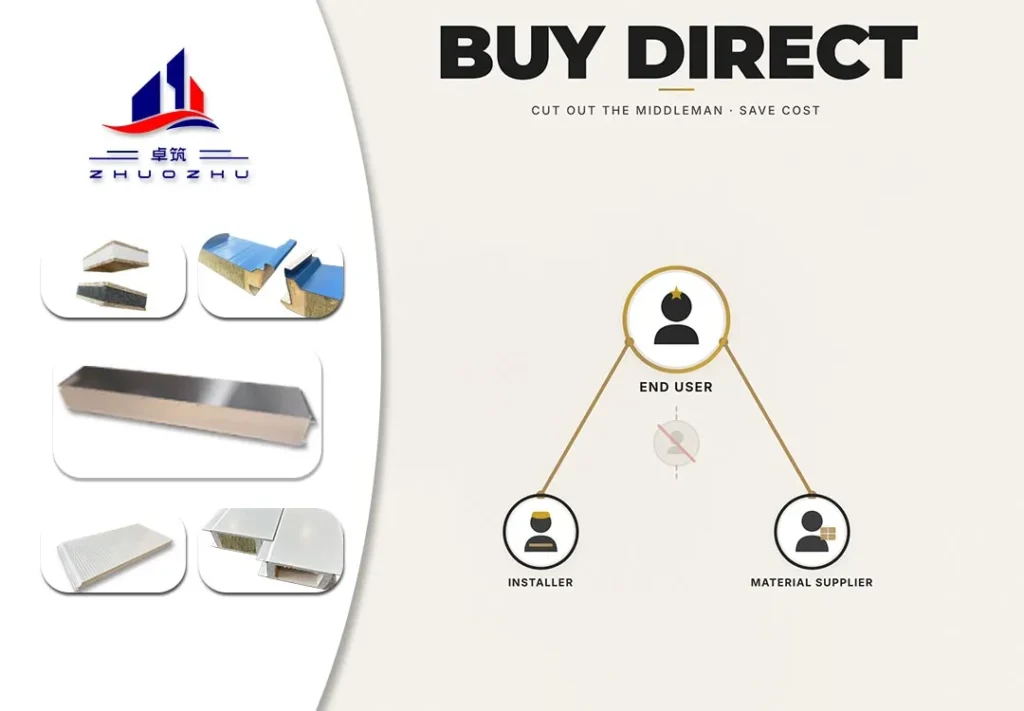
They’ve done the math: by sourcing directly from the materials factory and cutting out the middleman, they can save 15% to 20% on the overall cost.
As a sandwich panel supplier, ZHUOZHU feels this trend firsthand. In the past, we mostly dealt with general contractors or steel structure companies, and our quotes had to leave room for their management fees and profit margins. Now the phone calls coming directly to the factory from end users have clearly increased, and their questions are very specific: what density is the rock wool core, how thick is the color steel plate, can you include tax and shipping, how soon can you deliver.
Behind this is not just “wanting to save money”—that phrase doesn’t capture it. The more you talk to people, the more you realize that end users’ mindset is changing, and so are the rules of the game.
Where Does the 15%–20% Savings Actually Come From?
The general contracting model has its advantages: single-point responsibility, peace of mind. But the price of that peace of mind is that every layer of transfer generates cost. After a construction company takes the order, material procurement itself adds a management fee, on-site coordination adds another layer, plus financing costs and reasonable profit—by the time the final number lands on the owner’s books, it’s not unusual for it to be 20% above the factory gate price.
Information is far more transparent than before. If an owner wants rock wool sandwich panels, they can find manufacturers online, get a sense of market prices, and even come across peers sharing their purchase prices. On top of that, the investment entities for factories and warehouses have become increasingly dispersed over the past two years—many are SME owners who acquired land and are building their own facilities. Every penny is their own, so there’s no reason not to scrutinize the numbers.
More importantly, the envelope system accounts for a moderate share of overall construction cost—not too high, not too low—which makes it exactly the area most ripe for “squeezing out the water.” Steel structure main materials are transparently priced, labor costs have established market rates, and it’s precisely sandwich panels—highly customized, with complex specifications and parameters—that offer the most room for maneuvering in a general contractor’s quote. When owners negotiate directly, they squeeze out that layer of margin, and the 15% savings is real money that lands in their pocket.
Aren’t You Afraid of Buying Wrong When Sourcing Materials Yourself?
This is probably the biggest concern for end users when dealing directly with factories. With a general contractor, no matter how expensive, the construction company is responsible when problems arise. If you buy panels yourself and the core density is insufficient, the color steel thickness doesn’t meet spec, or the fire rating is wrong—the responsibility is all on you.
But interestingly, it’s precisely this fear of “buying wrong” that is forcing end users to become more professional. Several direct customers ZHUOZHU has recently taken on know the difference between rock wool and polyurethane inside out. Some ask directly, “Can your rock wool compressive strength reach 100KPa or above?” Others hold up drawings and ask, “Fire inspection requires Class A—does your panel’s test report correspond to that?”
The growing popularity of rock wool cores in industrial factories is itself a result of end users upgrading their material selection logic. A few years ago, polyurethane was cheaper and had better insulation, so everyone chose it without thinking. Now fire safety inspections are strict, factories have a lot of electrical equipment and combustibles, and once the envelope material becomes a channel for fire spread, the money saved on materials won’t cover the losses. End users sourcing materials themselves actually care more about “is it right” than “is it cheap”—sometimes more so than certain general contractors.
For ZHUOZHU, this is a good thing. We’re not afraid of customers who know their stuff—we’re afraid of customers who only compare prices without looking at specifications. Knowledgeable customers have lower communication costs, understand that rock wool costs more for good reason, know what the hydrophobicity index means during the rainy season in the south, and there’s less back-and-forth after the deal closes.
Where Do You Find a Construction Crew? It’s Actually Easier Than You’d Think
Materials are bought, but what about installation? When the general contractor handled everything, owners didn’t need to worry about this. Now they have to find a crew themselves—sounds troublesome, but in practice, many owners find it’s workable.
The labor market for steel structure envelope installation is actually quite mature. Light steel installation, wall panel laying, roof panel fixing—there are ready-made crews taking on jobs, and prices have established ranges: roof single-sheet installation runs a few yuan per square meter, wall panels around ten, with machinery and management fees on top. When owners find crews themselves, agree on unit prices and schedules, and start work as soon as materials arrive, one layer of subcontracting is eliminated, and the workers actually take home more.
ZHUOZHU’s role has become subtly different here too. In the past, we just delivered panels to the site, coordinated with the general contractor’s technician, and that was it. Now end users pull us aside and ask: “How do your panel tongues interlock? Do you supply trim pieces? Anything to watch out for during installation?” Put plainly, the supplier needs to take half a step forward and provide solid technical service so customers feel confident doing it themselves.
Our approach now is simple: confirm the panel layout drawing before shipment, supply all trim and closure pieces to actual dimensions, and include installation detail drawings with the shipment. If the crew an owner hires isn’t familiar with our panel profile, a video call and our workshop foreman explains against the actual product how to mount it, how to apply sealant, how to handle corners. This used to be the general contractor’s technician’s job. Now ZHUOZHU takes it on, and we don’t see it as a burden. Since end customers have chosen to skip the middleman and come directly to us, this level of service is simply part of the deal.
This Trend Won’t Reverse
From a supplier’s perspective, end users bypassing construction companies to buy materials directly is not some “industry chaos”—it’s the market forcing efficiency improvements. The value of general contracting lies in coordination and backstop responsibility, but once the information gap is closed and owners’ own expertise rises, the compression of pure “pass-through” links is inevitable.
ZHUOZHU’s response is simple: make product specifications transparent, make technical service solid, and make it worry-free for end users to come directly to us. The 15%–20% saved is what owners deserve. We earn our money from manufacturing and service—that middle layer was never ours to covet in the first place.
As for owners still on the fence, my advice is: if you’re building a standardized factory with a modest envelope area, the general contractor’s peace of mind is still worth paying for. But if you have clear requirements for materials, are willing to spend half a day understanding the difference between rock wool and polyurethane, and take a trip to the factory to see the production line—the money you save is enough to install two extra air conditioners in your facility.
