
Hello, I’m Wald, Product and Technical Director at Linyi Zhuozhu New Material Co., Ltd. In my work with steel structure projects around the world, one question comes up again and again: what is the best roofing panel for a steel frame building? My answer, in the vast majority of cases, is PIR sandwich panels. Today I want to explain why—not with marketing language, but with the engineering reasoning that matters to builders, buyers, and project owners.
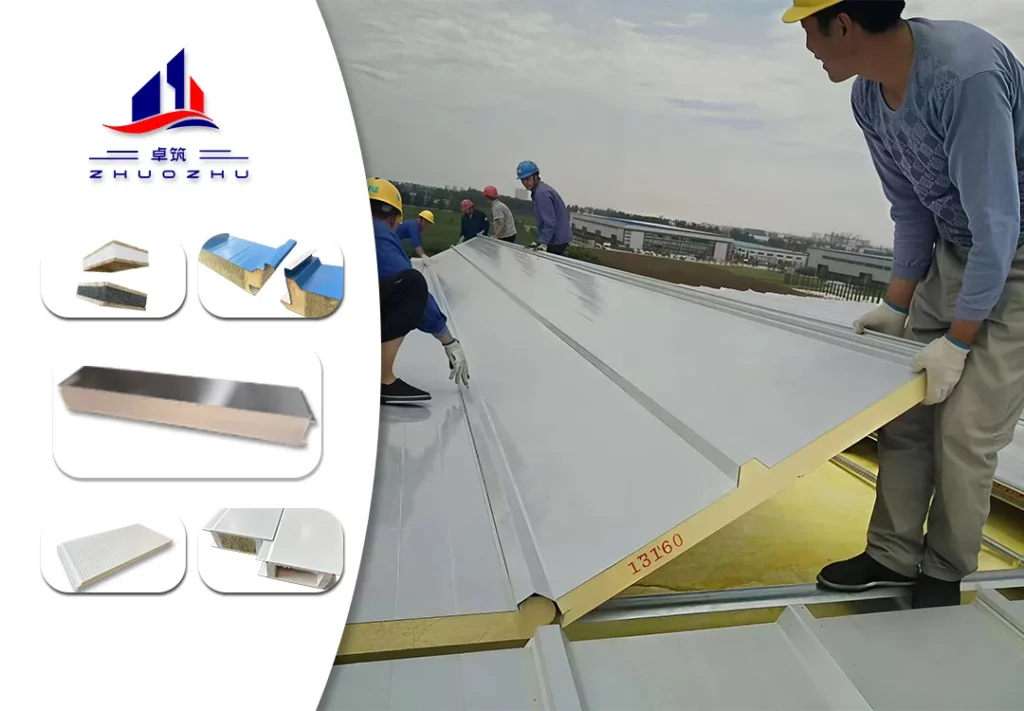
1. Superior Thermal Insulation Cuts Long-Term Energy Costs
PIR foam has one of the lowest thermal conductivity values among common insulation materials, typically around 0.022 W/m·K. On a large steel structure roof, where surface area is enormous and heat loss or heat gain is significant, this performance translates directly into lower energy bills. For temperature-controlled facilities—cold storage, food processing, pharmaceutical warehouses—the roof is often the largest source of thermal loss. A PIR roof panel minimizes that loss from day one and continues to do so for the life of the building.
2. Fire Performance That Meets Modern Regulations
PIR forms a stable char layer when exposed to fire and does not melt or drip. This is critical for roofing, where fire spread across the roof surface can be catastrophic. With increasingly strict fire codes worldwide, PIR sandwich panels can achieve classifications such as B-s1,d0 for reaction to fire, and specific thicknesses can be tested for fire resistance ratings like EI60 or EI120. For any steel structure where fire safety is a regulatory requirement, PIR is a dependable choice.
3. Lightweight Construction Reduces Steel Frame Costs
Steel structures are designed around dead loads. Every kilogram of roofing material must be supported by the steel frame, and heavier roofs require heavier beams, more columns, and larger foundations. PIR sandwich panels are remarkably light for the insulation performance they deliver. Compared with traditional roof assemblies—concrete, heavy insulation boards, multiple layers of waterproofing—a PIR roof panel dramatically reduces the dead load. This allows a lighter, more economical steel structure without compromising performance.
4. Fast Installation Saves Labor and Time
A PIR sandwich roof panel is a factory-finished composite. It arrives on site with insulation, weather barrier, and structural decking already bonded into a single product. Installation is a matter of lifting panels into place, engaging the joint profiles, and fastening them to the purlins. There is no separate insulation laying, no vapor barrier installation, no multiple trade coordination. On large steel structure roofs, this speed translates into significant savings in labor cost and project schedule.
5. Integrated Vapor Barrier and Airtightness
In a steel structure roof, moisture control is critical. A PIR sandwich roof panel has a closed-cell core and metal facings on both sides, creating an inherent vapor barrier and air seal. When the joints are properly detailed with sealant and the panel laps are engaged correctly, the roof becomes an airtight assembly. This prevents condensation inside the roof build-up, protects the steel structure from corrosion, and maintains insulation performance over time.
6. Long Service Life and Low Maintenance
PIR sandwich panels are manufactured with pre-painted galvanized steel facings. The coating systems are designed to resist UV degradation, weathering, and corrosion. Unlike traditional roofing systems that require periodic replacement of membranes or re-application of coatings, a properly installed PIR roof panel requires minimal maintenance. The roof stays watertight and thermally efficient for decades, reducing the total cost of ownership.
7. Complete System with Matched Accessories
A roof is not just panels. It is panels plus ridge caps, eave boxes, flashings, gutters, fasteners, and sealants. At ZHUOZHU, we supply the complete system—every accessory custom-bent to match the panel profile and the specific geometry of your building. This ensures that the roof performs as an integrated assembly, with no weak points where water or air can enter. We also provide shop drawings showing exactly how each panel and accessory interfaces with your steel frame.
8. Design Flexibility for Steel Structures
PIR sandwich panels are available in a range of thicknesses, profiles, and colors. They can be installed on pitched roofs, curved roofs, and low-slope roofs. For architects and engineers working with steel structures, this flexibility allows the roof to meet both performance requirements and aesthetic goals. Whether the building is a factory, warehouse, cold storage facility, or commercial structure, PIR roof panels can be specified to suit the design.
9. Engineered Support from ZHUOZHU
When you work with us, you get more than panels. Our engineering department reviews your drawings, calculates the precise panel quantities with appropriate loss allowance, and prepares detailed shop drawings. We help you select the right thickness, the right fire classification, and the right accessory system for your specific project. If your project requires certifications such as CE EN14509 or fire test reports to EN13501, we can advise on what is available and what testing may be required for your exact configuration.
A Final Thought
The roof is the most exposed part of any steel structure. It faces sun, rain, wind, and temperature extremes every day. It is also the largest continuous surface through which energy can escape. Choosing the right roofing system is not a minor decision—it determines the building’s energy performance, its fire safety, its maintenance cost, and its service life. PIR sandwich panels deliver on all these fronts, and that is why I recommend them for the majority of steel structure roof applications.
If you are planning a steel structure project and need guidance on PIR roof panels, reach out to me directly. I’m Wald, and I’m here to help you get the specification right from the start.
