
Prefabrication Advantages: The Efficiency Revolution of Sandwich Panels

Standardized Production Brings Qualitative Changes
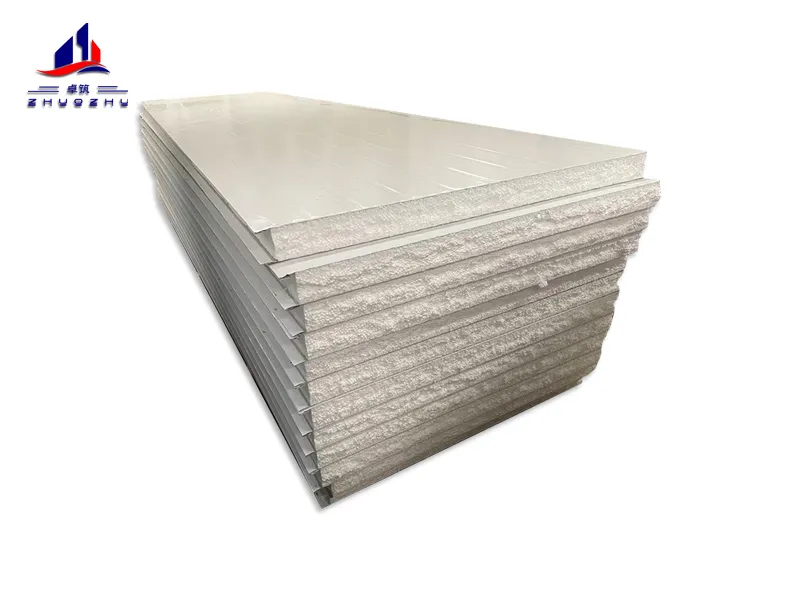
Sandwich panels adopt a factory prefabrication production model, achieving millimeter-level precision through precise digital control. In modern factories, each panel undergoes:
- Computer-aided design (CAD) for precise cutting
- Automated production lines controlling dimensional tolerance (±1mm)
- Standardized quality inspection processes
- Organized packaging and logistics management
On-site Installation Efficiency Data
According to actual project calculations, sandwich panel installation teams demonstrate remarkable performance:
- Skilled teams can install 600㎡ of wall panels in 8 hours
- Daily installation speed reaches 1500-2000㎡ under ideal conditions
- Project duration reduced by 60-70% compared to traditional masonry
- Labor requirements decreased by 50%
Case Study: Industrial Plant Project
An automotive parts factory using sandwich panels for construction:
- Building area: 12,000㎡
- Wall installation completed in 8 days
- Roof system completed in 5 days
- Total project duration: 45 days earlier than traditional methods
- Labor cost savings: approximately ¥350,000

Efficiency Bottlenecks of Traditional Materials

Complex On-site Construction Processes
Traditional building materials face multiple efficiency challenges:
Logistics Management Challenges
- Material transportation: Requires coordination of multiple vehicles and handling equipment
- On-site storage: Occupies large areas, increasing management costs
- Weather dependency: Rain and snow significantly impact construction progress
- Material waste: 5-10% material loss due to on-site processing
Construction Process Efficiency Analysis
Taking masonry work as an example:
- Skilled bricklayer’s daily output: 800-1000 standard bricks
- Equivalent to: 15-20㎡ wall area per person per day
- Requires supporting processes: mortar mixing, material handling, technical layout
- Quality control: Relies on on-site supervision with significant variables
Comparative Data from Actual Projects
Data from a commercial building project:
| Construction Method | Construction Period | Workforce Size | Weather Delay Days | Total Cost |
|---|---|---|---|---|
| Traditional Masonry | 90 days | 25 people | 12 days | ¥1.25 million |
| Sandwich Panels | 28 days | 12 people | 3 days | ¥980,000 |
In-depth Analysis of Efficiency Advantages

Economic Value of Time Costs
- Revenue generated from early occupancy
- Savings in capital carrying costs
- Reduction in management expenses
- Seizure of market opportunities
Fundamental Differences in Quality Control
- Factory environment: Stable and controllable production conditions
- On-site construction: Affected by multiple factors
- Product consistency: Standardization vs. customization
- Maintenance: Convenience of modular replacement
Industry Development Trends
Empowerment Through Digital Management
Perfect integration of modern project management software with sandwich panel construction:
- BIM technology simulates installation processes in advance
- Real-time progress tracking
- Precise material management
- Full-process traceable quality control
Workforce Structure Optimization
- Reduced reliance on specialized trades
- Lower technical barriers
- Improved construction safety
- Enhanced working conditions
Selection Recommendations
When to Prefer Sandwich Panels
- Time-sensitive key projects
- Areas with limited labor resources
- Projects requiring high construction precision
- Industrial projects needing rapid production
Suitable Scenarios for Traditional Materials
- Historical building restoration
- Special design requirements
- Small-scale renovation projects
- Extremely budget-constrained projects
Conclusion
Through prefabricated and standardized production and installation models, sandwich panels demonstrate significant advantages in construction efficiency. They not only substantially shorten project durations but also enhance project quality stability by reducing on-site work processes. Although traditional building materials still have their value in specific scenarios, sandwich panels provide more efficient and economical solutions for most modern construction projects.
With the deepening advancement of construction industrialization, prefabricated building materials like sandwich panels will play an increasingly important role in enhancing overall industry efficiency. Project decision-makers are advised to fully consider time costs and quality requirements when selecting materials, making choices that best serve the overall project benefits.
