
In the selection and combination of building materials, structural mechanical performance and material compatibility are crucial factors determining building safety and service life. As a professional building materials manufacturer, ZHUOZHU explicitly does not support the combination of timber frames and metal sandwich panels based on strict technical standards. Let’s explore the scientific rationale behind this technical decision.
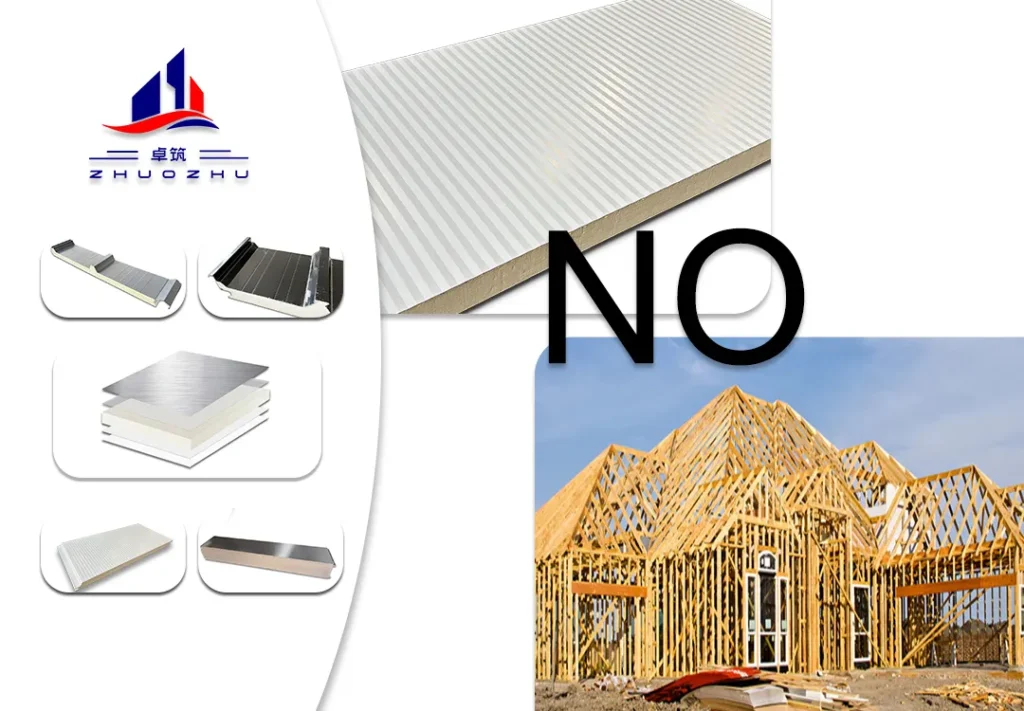
Structural Mechanics Compatibility Issues
From a load-bearing capacity perspective, timber frames typically have a load-bearing limit of 150-300kg/m², while standard 150mm thick metal rock wool sandwich panels weigh 25-35kg/m². When considering external factors like wind and snow loads, actual load requirements may double, approaching or even exceeding the safe load-bearing limit of timber frames.
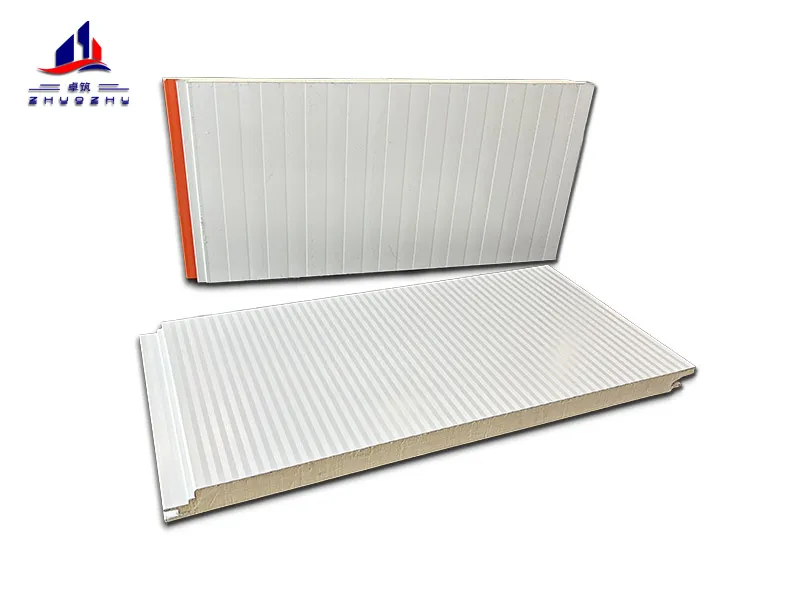
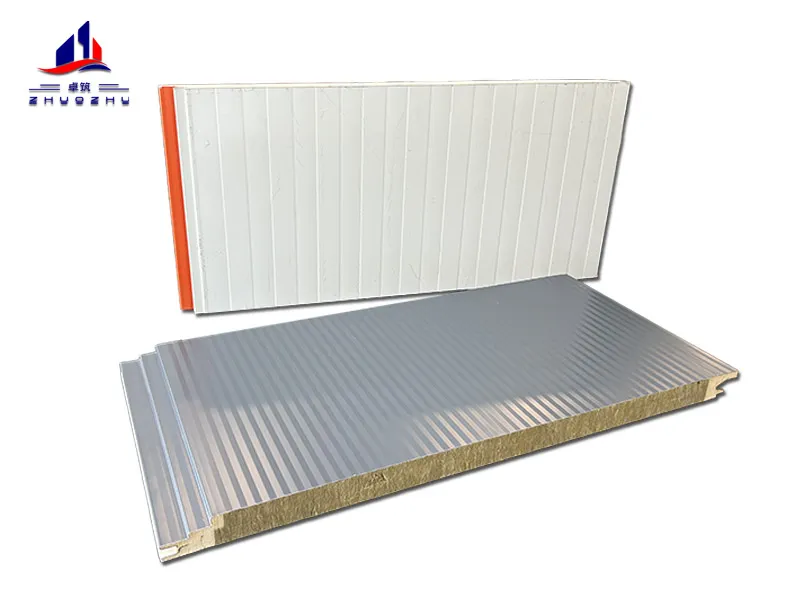
Stiffness mismatch is another critical issue. Wood has an elastic modulus of 8-12 GPa, which varies with moisture content, while metal panels have an elastic modulus of 200 GPa. This significant stiffness difference causes stress concentration, making connection points prone to fatigue failure.
Fundamental Differences in Material Properties
The difference in thermal expansion coefficients cannot be ignored. Wood has a longitudinal thermal expansion coefficient of 3-6×10⁻⁶/℃ and a radial coefficient of 30-60×10⁻⁶/℃, showing significant anisotropic characteristics. In comparison, steel has a thermal expansion coefficient of 11-13×10⁻⁶/℃, and aluminum reaches 23-24×10⁻⁶/℃, both being isotropic materials. These differences create irreconcilable internal stresses during temperature changes.
Humidity effects are another important consideration. Wood exhibits significant swelling and shrinking characteristics, with dimensions changing by 0.2-0.4% for every 1% change in moisture content. Metal materials are almost unaffected by humidity. This difference causes connection points to loosen during seasonal humidity changes, compromising building airtightness.
ZHUOZHU’s Recommended Compatible Combinations
For timber frame structures, we recommend the following proven reliable combinations:
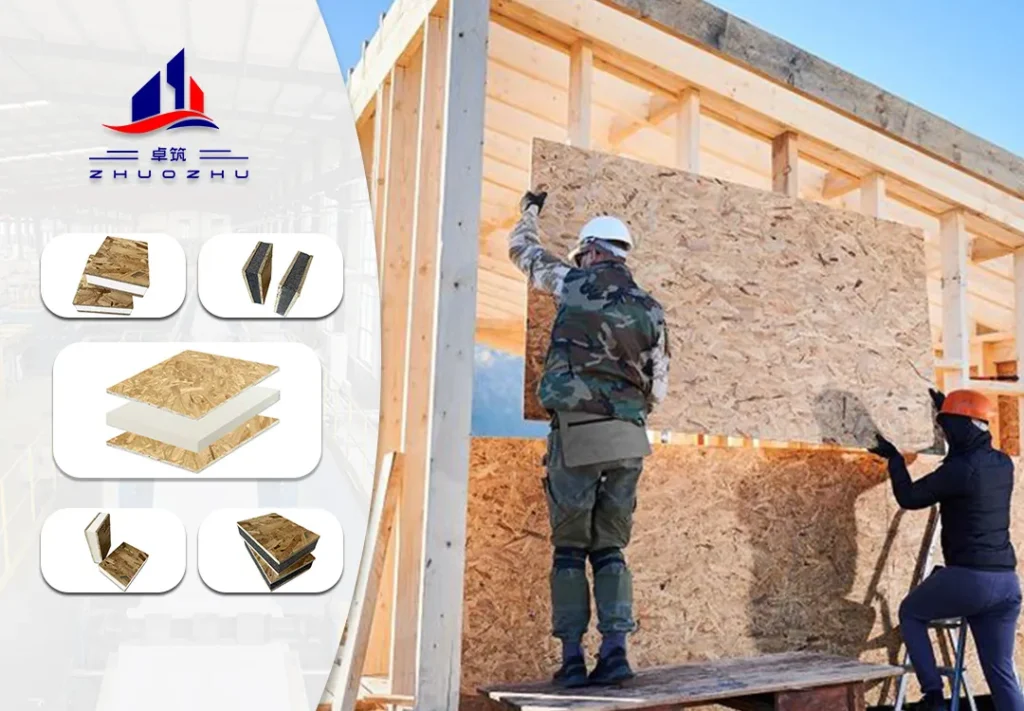
Timber frame with OSB structural insulated panels is the optimal choice. This combination offers perfect material compatibility, as both wood and OSB are wood-derived materials with similar thermal expansion characteristics. Construction allows for unified connection methods and tools, while maximizing material utilization.

Timber frame with metal carved panels is suitable for decorative applications. It’s important to note that this combination is limited to decorative, non-load-bearing uses, with panel thickness not exceeding 25mm. Specialized flexible connection systems must be used, with adequate deformation gaps reserved.
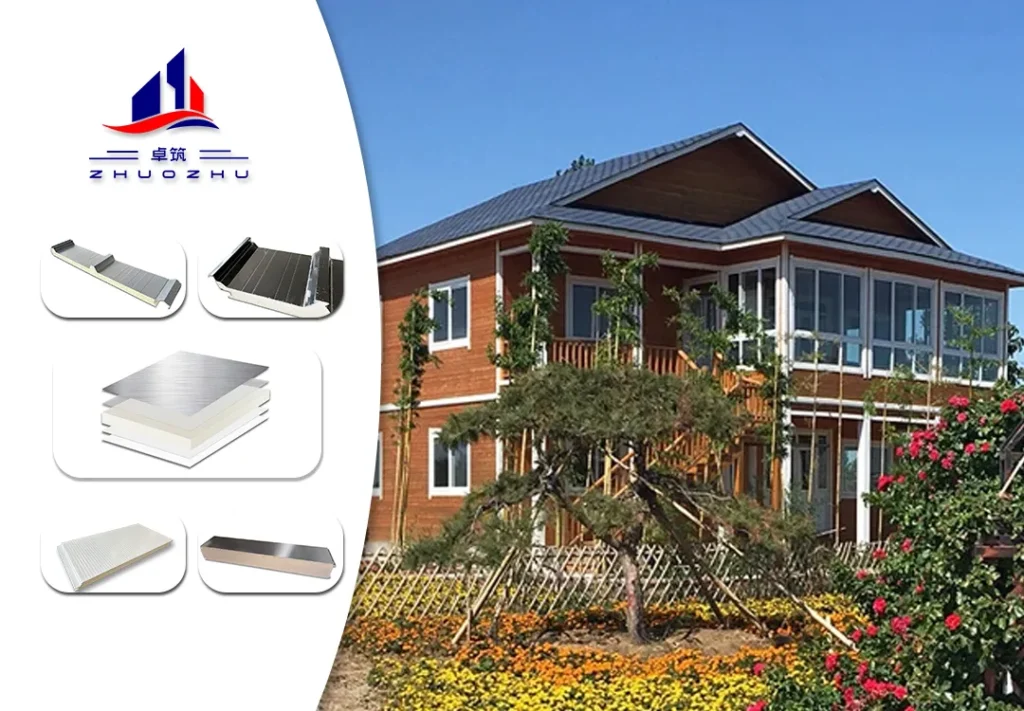
Timber frame with OSB panels is a traditional and reliable solution. This combination features mature construction techniques, reliable structural performance, good economic efficiency, and easy on-site adjustments.
Technical Considerations
Connection system failure risks require special attention. Wood has creep characteristics, causing continuous deformation under long-term loading, while metal connections create stress concentration, with rigid connections prone to local failure. Additionally, different cycles of wood decay and metal corrosion further exacerbate durability issues.
Thermal performance conflicts are also evident. A 100mm thick timber frame has a thermal resistance of approximately 0.14 m²K/W, while metal sandwich panels achieve 1.5-3.0 m²K/W. This difference creates significant thermal bridges at connection points, reducing overall insulation effectiveness.
Safety and Durability Analysis
From a structural safety perspective, accumulated deformation under long-term loading, different response characteristics during seismic events, and varying vibration frequencies under wind loads all pose safety risks.
Service life mismatch is another practical issue. Quality timber has a service life of 30-50 years under ideal conditions, while metal sandwich panels can last 40-60 years. This unsynchronized aging necessitates premature replacement of some components, increasing maintenance costs.
ZHUOZHU’s Technical Position
Based on materials science principles, we adhere to similar stiffness matching, thermal deformation coordination, and durability consistency principles. In engineering practice, we prioritize connection reliability, service life coordination, and maintenance cycle unification.
Professional Recommendations
For residential projects, prioritize timber frame with OSB structural insulated panel systems, or consider light steel frames with metal sandwich panels as an alternative. For limited budgets, timber frame with OSB panels plus external insulation system is an economical and practical choice.
For commercial projects, we recommend light steel studs with metal sandwich panels. For high-end projects, consider steel structures with metal sandwich panel curtain wall systems.
In building material selection, one cannot consider only individual material performance but must focus on the system performance of material combinations. The combination of timber frames and metal sandwich panels has been proven to have significant technical deficiencies in both theoretical analysis and engineering practice.
As a responsible building materials supplier, ZHUOZHU consistently adheres to scientific technical standards, recommending proven and reliable material combinations to our clients. We believe that correct material selection forms the foundation of building safety, durability, and superior performance.
For specific project material selection advice, our technical team provides free compatibility analysis and system solution recommendations.
