
The Evolution of Fire-Safe Wall Panel Technology
In the realm of industrial and commercial construction, rock wool sandwich panels have long been revered for their exceptional fire performance. As the only common insulated panel core material achieving Class A1 non-combustible classification, rock wool remains the default choice for applications where fire safety cannot be compromised—chemical plants, pharmaceutical facilities, high-rise buildings, and public assembly spaces.
However, not all rock wool panels are created equal. The industry has witnessed a significant evolution from first-generation pure rock wool panels to second-generation polyurethane (PU) edge-sealed rock wool panels. This advancement addresses fundamental limitations of the original technology while preserving its fire-safe excellence.
For specifiers, contractors, and building owners, understanding the differences between these two panel types is essential for selecting the right solution for each application. ZHUOZHU, with manufacturing expertise spanning both pure rock wool and advanced PU edge-sealed systems, provides this comprehensive comparison to guide your selection process.

Part 1: Understanding the Two Technologies
1.1 Pure Rock Wool Wall Panels: The First Generation
Construction:
Pure rock wool panels consist of a continuous rock wool (stone wool) core sandwiched between two metal facings. The core is homogeneous throughout the panel, with no additional materials at the edges.
Core Properties:
- Material: Basalt rock and recycled slag, spun into mineral fibers
- Density: 80-120 kg/m³ (standard range)
- Thermal Conductivity: 0.033-0.040 W/m·K
- Fire Rating: Class A1 (non-combustible)
- Melting Point: >1000°C
Advantages:
- Uncompromised fire safety throughout the entire panel
- Excellent acoustic absorption (Rw 35-45 dB)
- Proven performance over decades of use
- Cost-effective for standard applications
Limitations:
- Soft core with limited structural contribution
- Edge vulnerability during handling and installation
- Poor fastener holding power in the core material
- Thermal bridging at panel joints (metal-to-metal contact)
- Compression risk under sustained loads
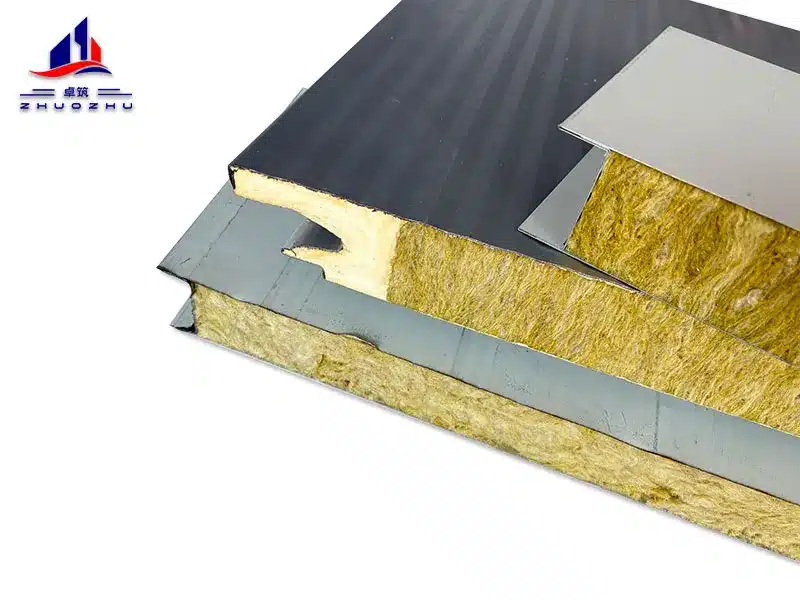
1.2 PU Edge-Sealed Rock Wool Wall Panels: The Second Generation
Construction:
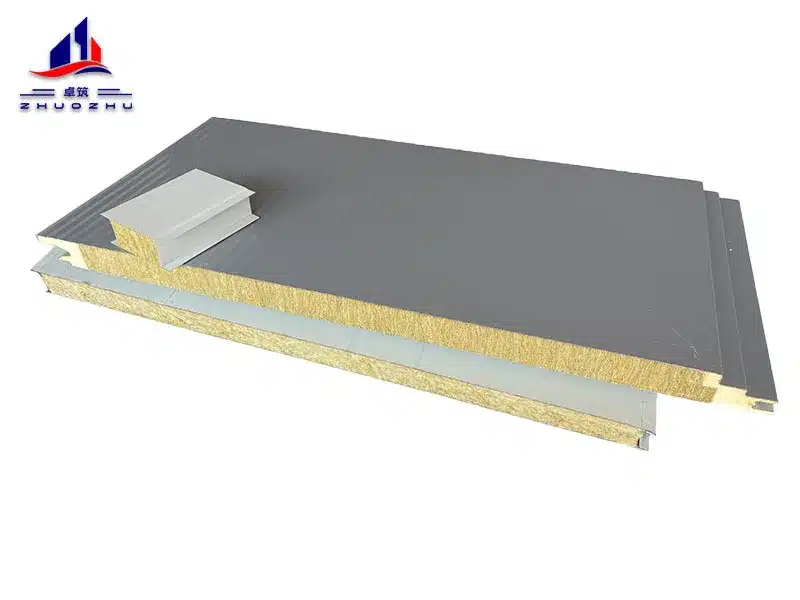
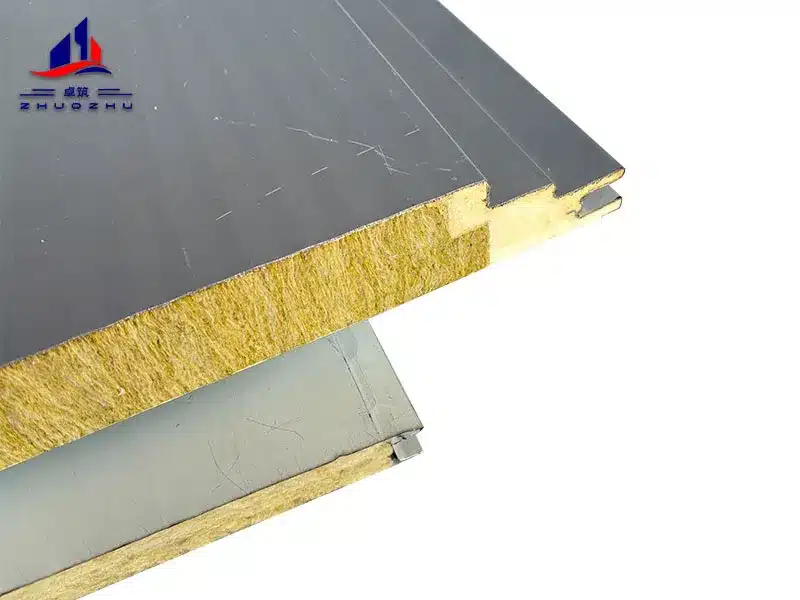
PU edge-sealed panels feature a rock wool core that is completely encapsulated along all four edges by high-density polyurethane foam. This creates a structural frame around the panel perimeter while maintaining the fire-safe rock wool core throughout the field of the panel.
Core Properties:
- Rock Wool Core: Same as pure panels (80-120 kg/m³, λ 0.033-0.040)
- PU Edge Seal: High-density polyurethane (80-120 kg/m³, structural grade)
- Edge Seal Width: 20-40mm along each edge
- Fire Rating: Class A1 (entire panel, including edge seals)
Advantages:
- All the fire safety of pure rock wool (Class A1 throughout)
- Enhanced structural integrity from PU edge frame
- Excellent fastener holding in edge zones
- Reduced thermal bridging at joints (PU provides thermal break)
- Protected edges reduce handling damage
- Improved airtightness at panel connections
Limitations:
- Higher initial cost than pure rock wool
- Slightly more complex manufacturing process
- Requires proper fastener placement in edge zones
Part 2: Head-to-Head Performance Comparison
2.1 Fire Safety
| Aspect | Pure Rock Wool | PU Edge-Sealed | Verdict |
|---|---|---|---|
| Core Fire Rating | Class A1 | Class A1 | Tie |
| Edge Fire Rating | Class A1 | Class B (with special PU formulation) | Tie |
| Smoke Development | s1 (minimal) | s1 (minimal) | Tie |
| Flaming Droplets | d0 (none) | d0 (none) | Tie |
| Fire Integrity at Joints | Good | Excellent (sealed edges) | PU Edge-Sealed |
Critical Note: The polyurethane used in edge seals for fire-rated panels is specially formulated with fire retardants to achieve Class A1 or A2 classification. Standard PU foam would not meet this requirement.
2.2 Structural Performance
| Parameter | Pure Rock Wool | PU Edge-Sealed | Improvement |
|---|---|---|---|
| Compressive Strength | ≥40 kPa | ≥60 kPa | 50% higher |
| Edge Crush Resistance | Low (fibrous) | High (solid PU) | 3-5x better |
| Bending Stiffness | Baseline | +25-35% | Significant |
| Dimensional Stability | Good | Excellent | Enhanced |
| Impact Resistance | Moderate | Good | 70% less edge damage |
2.3 Fastener Performance
This is one of the most significant differentiators between the two technologies:
| Fastener Aspect | Pure Rock Wool | PU Edge-Sealed | Advantage |
|---|---|---|---|
| Pull-Out Resistance | 300-500 N | 800-1200 N | 2-4x higher |
| Thread Engagement | Fibers only | Solid PU | Complete |
| Long-Term Creep | Potential | Minimal | PU Edge-Sealed |
| Vibration Resistance | Moderate | Excellent | PU Edge-Sealed |
| Sealing Surface | Soft, uneven | Solid, smooth | PU Edge-Sealed |
Why It Matters: In high-wind regions or applications with significant thermal movement, connection reliability is critical. The PU edge seal transforms the panel’s perimeter into a structural zone where fasteners can achieve reliable, long-term holding power.
2.4 Thermal Performance
| Thickness | Pure Rock Wool U-Value | PU Edge-Sealed U-Value | Improvement |
|---|---|---|---|
| 80mm | 0.45 W/m²K | 0.40 W/m²K | 11% |
| 100mm | 0.36 W/m²K | 0.31 W/m²K | 14% |
| 120mm | 0.30 W/m²K | 0.25 W/m²K | 17% |
| 150mm | 0.24 W/m²K | 0.20 W/m²K | 17% |
Thermal Bridging Reduction:
- Pure Rock Wool: Metal-to-metal contact at joints creates significant thermal bridges
- PU Edge-Sealed: Polyurethane at edges provides continuous thermal break
- Linear Thermal Transmittance (Ψ-value): Reduced by 60-70% with edge sealing
2.5 Acoustic Performance
| Parameter | Pure Rock Wool | PU Edge-Sealed | Difference |
|---|---|---|---|
| Sound Reduction (Rw) | 35-45 dB | 35-45 dB | Comparable |
| Sound Absorption | Excellent | Excellent | Comparable |
| Joint Sound Leakage | Potential | Minimized | PU Edge-Sealed |
The rock wool core provides excellent acoustic performance in both panel types. The PU edge seal primarily improves sound isolation at panel joints by creating better seals.
2.6 Installation and Handling
| Aspect | Pure Rock Wool | PU Edge-Sealed | Advantage |
|---|---|---|---|
| Edge Protection | None (fibrous exposed) | Protected by PU | PU Edge-Sealed |
| Handling Damage Risk | High | Low | PU Edge-Sealed |
| Fastener Placement | Anywhere (but limited hold) | Edge zones optimal | PU Edge-Sealed |
| Joint Sealing | Requires care | Easier (solid surface) | PU Edge-Sealed |
| Panel Weight | Same | Same | Tie |
| Cutting Difficulty | Moderate | Moderate | Tie |
Part 3: Application-Specific Recommendations
3.1 When to Choose Pure Rock Wool Panels
Pure rock wool panels remain an excellent choice for many applications where the enhanced features of edge-sealed panels are not required:
Ideal Applications:
- Interior Partitions: Where structural demands are minimal
- Low-Rise Buildings: Limited wind loads and thermal movement
- Budget-Conscious Projects: Where initial cost is primary driver
- Non-Critical Areas: Where fastener performance is not paramount
- Acoustic-Focused Spaces: Where sound absorption is main requirement
- Temporary Structures: Limited service life doesn’t justify premium
Selection Criteria:
- Fire safety required but structural loads are modest
- Panel heights under 6 meters
- Moderate climate with limited temperature extremes
- Projects with careful handling and experienced installers
3.2 When to Choose PU Edge-Sealed Rock Wool Panels
PU edge-sealed panels justify their premium in applications where structural demands meet fire safety requirements:
Ideal Applications:
- High-Rise Buildings: Significant wind loads and safety requirements
- Chemical Plants: Fire safety plus structural integrity
- Pharmaceutical Facilities: Regulatory compliance with durability
- Cold Storage with Fire Requirements: Low temperatures plus fire safety
- Hurricane/Wind Zones: Enhanced fastener holding critical
- High-Traffic Industrial Areas: Where impact resistance matters
- Long-Span Applications: Reduced intermediate support requirements
- Critical Infrastructure: Data centers, hospitals, emergency facilities
Selection Criteria:
- Panel heights exceed 8 meters
- High wind load设计要求 (≥1.5 kPa)
- Significant temperature differentials
- Vibration exposure (near railways, machinery)
- Long service life expectations (25+ years)
3.3 Decision Matrix
| Project Factor | Pure Rock Wool | PU Edge-Sealed |
|---|---|---|
| Fire Safety Priority | ✓✓✓ | ✓✓✓ |
| Budget Constraint | ✓✓✓ | ✓ |
| High Wind Region | ✓ | ✓✓✓ |
| Seismic Zone | ✓ | ✓✓✓ |
| Long Spans (>8m) | ✓ | ✓✓✓ |
| Critical Fastener Reliability | ✓ | ✓✓✓ |
| Minimal Thermal Bridging | ✓ | ✓✓✓ |
| Rapid Installation Priority | ✓✓ | ✓✓ |
| Limited Handling Care | ✓ | ✓✓✓ |
Part 4: Technical Specifications Comparison
4.1 Dimensional Options
| Specification | Pure Rock Wool | PU Edge-Sealed |
|---|---|---|
| Thickness Range | 50-200mm | 50-200mm |
| Standard Width | 1000mm | 1000mm |
| Maximum Length | Up to 12m | Up to 12m |
| Edge Seal Width | N/A | 20-40mm |
| Tolerances | ±2mm thickness, ±5mm length | Same |
4.2 Physical Properties Comparison Table
| Property | Pure Rock Wool | PU Edge-Sealed | Test Standard |
|---|---|---|---|
| Core Density | 80-120 kg/m³ | 80-120 kg/m³ | EN 1602 |
| Edge Density | N/A | 80-120 kg/m³ (PU) | EN 1602 |
| Thermal Conductivity (λ) | 0.033-0.040 W/m·K | 0.033-0.040 W/m·K (core) | EN 12667 |
| Compressive Strength | ≥40 kPa | ≥60 kPa | EN 826 |
| Tensile Strength Perpendicular | ≥7.5 kPa | ≥10 kPa | EN 1607 |
| Fire Classification | A1 | A1 | EN 13501-1 |
| Water Absorption (short term) | <1 kg/m² | <1 kg/m² | EN 1609 |
| Water Vapor Resistance Factor (μ) | ~1 | ~1 (core) | EN 12086 |
Part 5: Installation Considerations
5.1 Handling and Storage
Pure Rock Wool Panels:
- Require careful handling to protect exposed edges
- Edge damage during transport more common
- Damaged edges may require field repair or panel replacement
- Stacking requires edge protection
PU Edge-Sealed Panels:
- Protected edges resist handling damage
- Can tolerate normal construction site conditions
- Reduced waste from edge damage
- Stacking less critical (edges protected)
5.2 Fastening Requirements
Pure Rock Wool Panels:
- Fasteners must rely primarily on facing engagement
- Limited pull-out resistance
- More fasteners may be required for equivalent security
- Washer size may need to be larger to distribute load
PU Edge-Sealed Panels:
- Fasteners should target edge zones (20-40mm from edges)
- Excellent pull-out resistance in PU zone
- Fewer fasteners may achieve same security
- Standard washer sizes sufficient
Fastener Spacing Comparison:
For a typical 10m wall height in 150 km/h wind zone:
- Pure Rock Wool: Fasteners at 300mm centers
- PU Edge-Sealed: Fasteners at 400-500mm centers
- Result: 25-40% fewer fasteners, faster installation
5.3 Joint Sealing
Pure Rock Wool Panels:
- Joint surfaces are fibrous and uneven
- Gaskets may not compress uniformly
- Sealant adhesion can be inconsistent
- Higher risk of air leakage
PU Edge-Sealed Panels:
- Joint surfaces are smooth, solid PU
- Gaskets compress uniformly
- Sealant adheres reliably
- Superior airtightness achievable
Part 6: Economic Analysis
6.1 Cost Comparison
| Cost Factor | Pure Rock Wool | PU Edge-Sealed | Difference |
|---|---|---|---|
| Panel Material Cost | Baseline | +10-15% | Higher initial cost |
| Installation Labor | Baseline | -5-10% | Lower labor cost |
| Fastener Quantity | Baseline | -25-40% | Material savings |
| Edge Damage Waste | 3-5% typical | <1% typical | Material savings |
| Maintenance (10 years) | Baseline | Lower | Reduced lifecycle cost |
| Total Installed Cost | Baseline | +2-8% | Modest premium |
6.2 Value-Added Benefits
The modest premium for PU edge-sealed panels delivers significant value:
- Reduced Risk: Lower probability of connection failure
- Energy Savings: 15-20% better thermal performance at joints
- Longer Service Life: Enhanced durability extends building life
- Fewer Callbacks: Reduced warranty claims from edge damage
- Design Flexibility: Longer spans, fewer supports
6.3 ROI Analysis
For a typical 10,000m² industrial building:
| Scenario | Pure Rock Wool | PU Edge-Sealed | Net Benefit |
|---|---|---|---|
| Initial Cost | $500,000 | $540,000 | +$40,000 |
| Energy Savings (20 yrs) | Baseline | $60,000 | +$60,000 |
| Maintenance Savings | Baseline | $20,000 | +$20,000 |
| Risk Reduction Value | Baseline | Significant | Insurance value |
| 20-Year Net Position | Baseline | +$40,000 + risk reduction | Positive ROI |
Part 7: ZHUOZHU’s Product Offering
7.1 Pure Rock Wool Wall Panels
ZHUOZHU Standard Rock Wool Panels:
- Core: High-quality rock wool, 80-120 kg/m³
- Facings: 0.5-0.7mm steel with various coatings
- Thickness: 50-200mm
- Width: 1000mm standard
- Length: Custom up to 12m
- Fire Rating: Class A1 certified
- Best For: Interior partitions, low-rise buildings, budget projects
7.2 PU Edge-Sealed Rock Wool Wall Panels
ZHUOZHU Edge-Sealed Premium Panels:
- Core: Premium rock wool, 80-120 kg/m³
- Edge Seal: High-density PU (80-120 kg/m³), fire-retardant formulation
- Seal Width: 30mm standard (customizable 20-50mm)
- Facings: 0.5-0.7mm steel, enhanced coatings available
- Thickness: 50-200mm
- Width: 1000mm standard
- Length: Custom up to 12m
- Fire Rating: Class A1 (entire panel certified)
- Best For: High-rise, chemical plants, pharmaceutical, wind zones
7.3 Quality Assurance
Both product lines undergo rigorous testing:
- Raw Material Verification: Rock wool density and fiber quality
- In-Process Control: Continuous monitoring during lamination
- Finished Product Testing: Fire performance, thermal, structural
- Third-Party Certification: Independent verification of ratings
Conclusion: Making the Right Choice
The evolution from pure rock wool wall panels to PU edge-sealed rock wool panels represents a significant advancement in building envelope technology—one that addresses the historic limitations of rock wool while preserving its essential fire-safe properties.
Choose Pure Rock Wool Panels When:
- Fire safety is required but structural demands are modest
- Budget constraints are primary
- Panel heights are under 6 meters
- Installation will be handled by experienced crews
- The building has moderate service life expectations
Choose PU Edge-Sealed Panels When:
- Both fire safety AND structural performance are critical
- Panel heights exceed 8 meters
- The building is in high-wind or seismic zones
- Fastener reliability is paramount
- Thermal bridging must be minimized
- Long-term durability justifies premium investment
The ZHUOZHU Advantage:
With manufacturing capabilities for both panel types, ZHUOZHU offers unbiased guidance to help you select the optimal solution for your specific application. Our technical team understands the nuances of each technology and can provide performance data, installation guidance, and project-specific recommendations.
Whether you choose the proven reliability of pure rock wool or the enhanced performance of PU edge-sealed panels, you benefit from ZHUOZHU’s commitment to quality, consistency, and customer support.
Contact our technical team today to discuss your project requirements and determine which rock wool panel solution is right for you.
About the Author
Wald is the Chief Engineer at ZHUOZHU with specialized expertise in fire-safe insulated panel systems. His work focuses on advancing rock wool technology and optimizing panel performance for critical industrial applications. Learn More About Us
