
Solving the Structural Challenge of Rock Wool Insulation
Rock wool has long been recognized as the gold standard for fire safety in insulated building panels. Its Class A1 non-combustible properties make it indispensable for facilities where fire risk cannot be compromised—chemical plants, pharmaceutical manufacturing, high-rise buildings, and public assembly spaces. However, architects, engineers, and installers have long grappled with a fundamental limitation: rock wool’s inherent softness and lack of structural rigidity.

Traditional rock wool sandwich panels, while offering exceptional fire protection, present several challenges:
- Compressive Weakness: The fibrous core compresses under load, reducing structural integrity
- Edge Vulnerability: Panel edges are prone to damage during handling and installation
- Connection Concerns: Fasteners lack sufficient holding power when driven through fibrous material
- Thermal Bridging: Metal-to-metal contact at panel edges creates energy efficiency gaps
- Long-Term Settling: Potential for core compression over time, affecting panel performance
These limitations led to the development of a second-generation solution: PU edge-sealed rock wool sandwich panels. By combining the fire-safe excellence of rock wool with the structural strength of polyurethane edge framing, manufacturers have created a hybrid panel that delivers the best of both worlds. ZHUOZHU, with advanced manufacturing capabilities in both rock wool sandwich panels and PIR technology, provides this comprehensive guide to understanding, specifying, and benefiting from this innovative panel system.
Part 1: Understanding the First Generation – Traditional Rock Wool Panels
1.1 The Fire-Safe Foundation
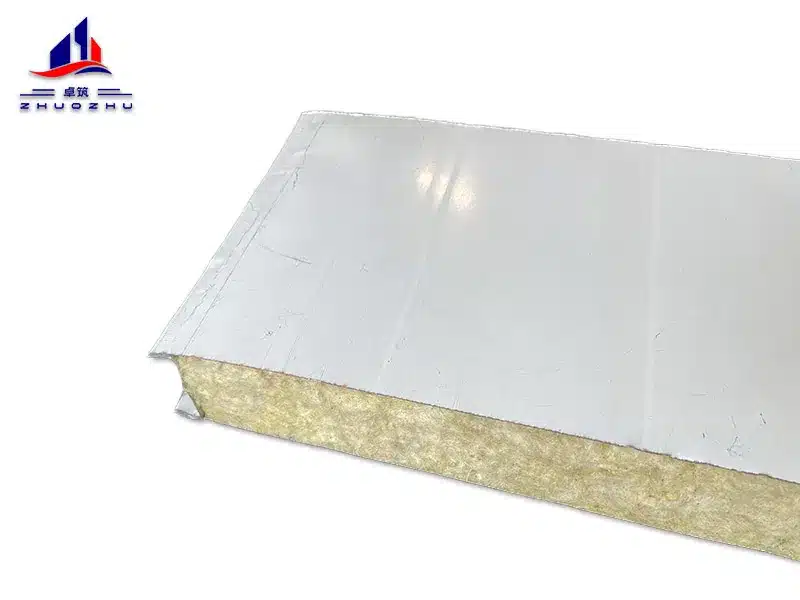
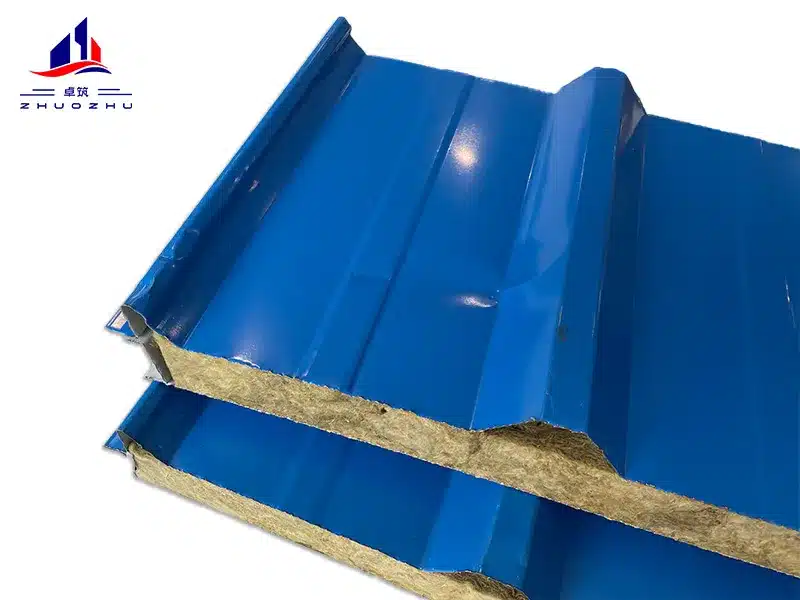
Traditional rock wool sandwich panels were developed to address applications where fire safety is paramount:
Core Properties:
- Material: Basalt rock and recycled slag, spun into mineral fibers
- Fire Rating: Class A1 (non-combustible) per EN 13501-1
- Thermal Conductivity: 0.033-0.040 W/m·K
- Density Range: 80-120 kg/m³ (standard formulations)
- Melting Point: >1000°C (fibers do not melt or contribute to fire spread)
Advantages That Made Them Essential:
- Zero Fire Contribution: Completely non-combustible, adding no fuel to fires
- Smoke Suppression: Minimal smoke development (s1 classification)
- No Flaming Droplets: d0 rating prevents secondary fire spread
- Acoustic Excellence: Superior sound absorption (Rw 35-45 dB)
- Proven Performance: Decades of successful use in fire-critical applications
1.2 The Structural Limitations
Despite these advantages, traditional rock wool panels have inherent weaknesses stemming from the fibrous nature of the core material:
| Challenge | Cause | Consequence |
|---|---|---|
| Compressive Weakness | Fibers compress under load | Panel deformation, reduced insulation thickness |
| Edge Vulnerability | Unprotected edges damage easily | Installation difficulties, compromised aesthetics |
| Fastener Holding Power | Fibers lack grip | Loose connections, potential panel movement |
| Thermal Bridging | Metal edges contact directly | Energy loss, condensation risk at joints |
| Core Settling | Gravity compression over time | Performance degradation, thermal gaps |
The Fastener Problem:
When screws are driven through traditional rock wool panels, they pass through fibrous material with minimal resistance. The threads engage primarily with the thin metal facings, providing limited pull-out resistance. In high-wind regions or applications with significant thermal movement, this can lead to connection failures over time.
The Edge Issue:
Panel edges—the most critical area for joint integrity—are essentially exposed fibrous material. During transport, handling, and installation, these edges are prone to damage, crushing, or deformation, compromising the quality of panel-to-panel connections.
Part 2: The Second Generation – PU Edge-Sealed Technology
2.1 The Innovation: Combining Rock Wool with Structural Polyurethane
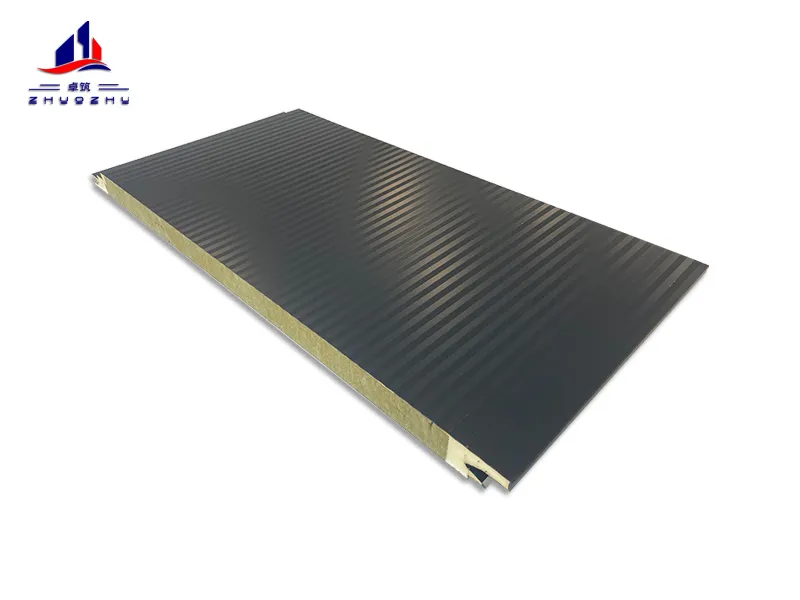
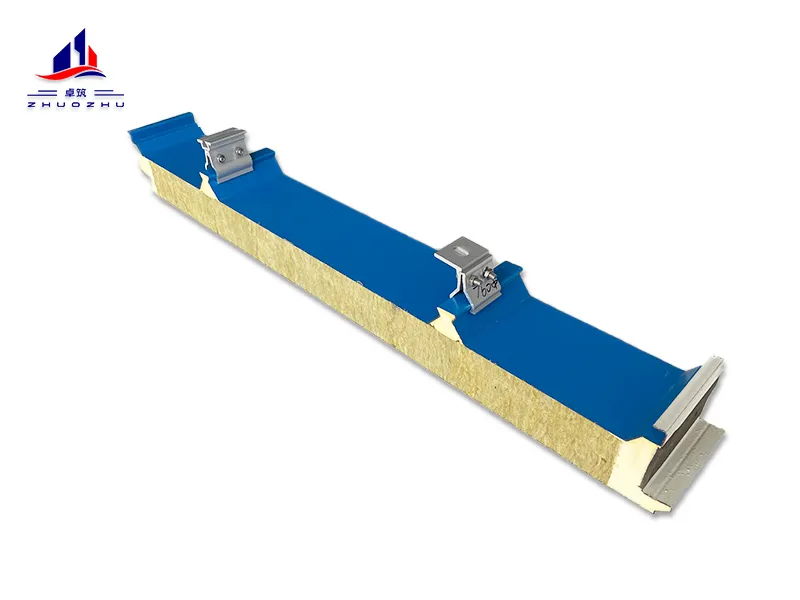
The evolution to second-generation PU edge-sealed rock wool sandwich panels addresses first-generation limitations through a simple but ingenious innovation: encapsulating the panel perimeter in high-density polyurethane foam.
Manufacturing Process:
Traditional Rock Wool Panel:
┌─────────────────────────────────┐
│  Metal Facing                    │
│  Rock Wool Core (fibrous)        │
│  Metal Facing                    │
└─────────────────────────────────┘
          (exposed edges)

PU Edge-Sealed Rock Wool Panel:
┌─────────────────────────────────┐
│  Metal Facing                    │
│  Rock Wool Core (fibrous)        │
│  Metal Facing                    │
├─────────────────────────────────┤
│  PU Edge Seal (all four sides)   │
└─────────────────────────────────┘
2.2 How It Works
During panel production, after the rock wool core is positioned between metal facings, high-density polyurethane foam is injected along all four edges. This creates a continuous structural frame around the entire panel perimeter.
Critical Characteristics of the PU Edge Seal:
- Density: Typically 80-120 kg/m³ (higher than standard PIR foam)
- Thickness: Matches the panel’s overall thickness (50-200mm)
- Width: 20-40mm along each edge
- Bonding: Chemically fuses to both metal facings and rock wool core
2.3 Performance Transformation
The PU edge seal fundamentally changes panel behavior:
| Performance Aspect | Traditional Rock Wool | PU Edge-Sealed Rock Wool | Improvement |
|---|---|---|---|
| Edge Strength | Low (fibrous, crushes easily) | High (solid polyurethane) | Structural integrity |
| Fastener Holding | Poor (fibers only) | Excellent (PU provides grip) | Secure connections |
| Compressive Resistance | Moderate | High (frame carries load) | Reduced deformation |
| Thermal Bridging | Significant (metal-to-metal) | Minimal (PU thermal break) | 15-25% energy savings |
| Joint Airtightness | Variable | Excellent (sealed edges) | Improved envelope performance |
| Handling Durability | Edges damage easily | Edges protected | Reduced installation waste |
Part 3: Technical Specifications and Performance Data
3.1 Material Composition
ZHUOZHU PU Edge-Sealed Rock Wool Panels:
| Component | Material | Key Properties |
|---|---|---|
| Core Insulation | Rock wool (stone wool) | Density: 80-120 kg/m³, λ: 0.033-0.040 W/m·K |
| Edge Seal | High-density polyurethane | Density: 80-120 kg/m³, structural grade |
| Interior Facing | Galvanized/pre-painted steel | 0.5-0.7mm, various coatings |
| Exterior Facing | Galvanized/pre-painted steel | 0.7-1.0mm, PVDF/HDP coatings |
| Adhesive | Two-part polyurethane | Structural bonding throughout |
3.2 Dimensional Options
- Panel Thickness: 50mm, 80mm, 100mm, 120mm, 150mm, 200mm
- Effective Width: 1000mm standard (950mm, 1150mm available)
- Panel Length: Up to 12 meters (transport optimized)
- Edge Seal Width: 20-40mm per edge (customizable)
3.3 Performance Specifications
Thermal Performance:
- Rock Wool Core λ: 0.033-0.040 W/m·K
- PU Edge Seal λ: 0.022-0.024 W/m·K
- Overall Panel U-Value: Improved by edge sealing (see table)
| Thickness | Standard Rock Wool U | PU Edge-Sealed U | Improvement |
|---|---|---|---|
| 80mm | 0.45 W/m²K | 0.40 W/m²K | 11% |
| 100mm | 0.36 W/m²K | 0.31 W/m²K | 14% |
| 120mm | 0.30 W/m²K | 0.25 W/m²K | 17% |
| 150mm | 0.24 W/m²K | 0.20 W/m²K | 17% |
Fire Performance:
- Fire Classification: Class A1 (entire panel—core and edge seals tested)
- Edge Seal Contribution: PU formulation specifically designed to maintain non-combustible classification
- Smoke Development: s1 (minimal smoke)
- Flaming Droplets: d0 (none)
Structural Performance:
- Compressive Strength: ≥60 kPa (enhanced by edge frame)
- Fastener Pull-Out Resistance: ≥2.5x improvement over standard rock wool
- Bending Stiffness: 25-35% improvement due to edge reinforcement
- Impact Resistance: Edge protection reduces damage risk by 70%
3.4 Joint System Performance
The PU edge seal enables superior joint detailing:
- Tongue-and-Groove Compatibility: Precision-machined edges maintain profile
- Integrated Gaskets: EPDM seals compress against solid PU surface
- Thermal Break Continuity: PU at edge eliminates metal-to-metal contact
- Airtightness: Achieves <0.5 m³/h·m² at 50Pa (Class A2)
Part 4: The Fastener Advantage – Why It Matters
4.1 The Physics of Fastener Holding Power
When a self-drilling screw penetrates a sandwich panel, its holding power depends on the material engaging the threads:
In Standard Rock Wool Panels:
- Screw passes through fibrous material with minimal engagement
- Primary holding power comes from facings only
- Threads cannot grip soft fibers effectively
- Pull-out resistance: 300-500 N typical
In PU Edge-Sealed Panels:
- Screw penetrates solid polyurethane at panel edges
- Threads fully engage with dense, structural foam
- Secondary engagement with facings
- Pull-out resistance: 800-1200 N typical (2-4x improvement)
4.2 Installation Best Practices
For PU Edge-Sealed Panels, installers should:
- Target the Edge Zone: Position fasteners within the PU-sealed perimeter
- Verify Engagement: Ensure screw penetrates PU (not just rock wool)
- Use Appropriate Fasteners: Self-drilling screws with proper washer seals
- Follow Spacing Guidelines: Per engineering specifications
Fastener Placement Diagram:
Panel Edge Detail:
┌─────────────────────────────────┐
│                                 │
│    Rock Wool Core               │
│                                 │
├─────────────────────────────────┤
│  PU Edge Seal Zone              │ ← Install fasteners here
│  (20-40mm)                      │
└─────────────────────────────────┘
4.3 Connection Reliability Over Time
The PU edge seal provides long-term connection stability:
- Creep Resistance: PU maintains grip under sustained loads
- Thermal Movement Accommodation: Flexible connection absorbs expansion/contraction
- Vibration Damping: Better energy absorption than metal-to-metal
- Corrosion Isolation: PU separates dissimilar metals where applicable
Part 5: Applications Where PU Edge-Sealed Rock Wool Excels
5.1 High-Wind and Cyclone Regions
In areas subject to extreme wind events, connection reliability is critical:
- Wind Uplift Resistance: Enhanced fastener holding power withstands negative pressures
- Dynamic Load Performance: Better energy absorption during wind gusts
- Building Safety: Reduced risk of panel detachment during cyclones
5.2 Fire-Critical Facilities with High Structural Demands
Applications requiring both Class A1 fire safety and robust structural performance:
- Chemical Processing Plants: Fire-safe enclosure with structural integrity
- Pharmaceutical Manufacturing: Non-combustible walls supporting equipment
- Data Centers: Fire protection plus secure connections for sensitive equipment
- High-Rise Buildings: Non-combustible cladding with wind load resistance
5.3 Cold Storage with Fire Requirements
Where low temperatures meet fire safety needs:
- Refrigerated Warehouses: Fire-rated enclosures with reliable seals
- Food Processing Freezers: Hygienic, non-combustible surfaces
- Pharmaceutical Cold Rooms: Temperature control plus fire protection
5.4 Transportation and Infrastructure
Applications subject to vibration and movement:
- Airport Facilities: Non-combustible construction with durable connections
- Railway Buildings: Vibration-resistant panel systems
- Tunnel Cladding: Fire-safe surfaces with secure attachments
Part 6: Installation Advantages
6.1 Reduced Handling Damage
The PU edge seal protects panels during the construction process:
- Transport Protection: Edges resist crushing during shipping
- Site Handling: Less damage during offloading and staging
- Installation Durability: Tolerates minor impacts without edge compromise
6.2 Improved Joint Quality
Installers achieve better results with PU edge-sealed panels:
- Consistent Gasket Compression: Solid edge surface ensures uniform sealing
- Precision Alignment: Protected edges maintain dimensional accuracy
- Clean Sealant Application: Smooth surface for secondary sealing
- Visual Quality: Clean, finished appearance at panel joints
6.3 Faster Installation
The enhanced edge durability translates to installation efficiency:
- Less Rework: Fewer damaged panels requiring replacement
- Faster Fastening: Clear target zone for fastener placement
- Easier Handling: Protected edges reduce caution requirements
- Confident Connections: Known performance of PU-engaged fasteners
Part 7: ZHUOZHU’s PU Edge-Sealed Rock Wool Systems
7.1 Manufacturing Excellence
ZHUOZHU’s production process ensures consistent edge seal quality:
- Precision Injection: Computer-controlled PU dispensing
- Density Control: Uniform 80-120 kg/m³ edge seals
- Full Perimeter Coverage: All four edges sealed (not just sides)
- Integrated Curing: In-line process for optimal bond strength
7.2 Product Range
| Panel Type | Thickness Range | Best Application |
|---|---|---|
| Wall Panels | 50-150mm | Vertical enclosures, fire walls |
| Roof Panels | 80-200mm | Industrial roofing with fire requirements |
| Partition Panels | 50-100mm | Internal fire compartmentation |
| Cold Room Panels | 100-200mm | Low-temperature + fire safety |
7.3 Customization Options
- Edge Seal Width: Customizable (20-50mm) for specific fastener patterns
- Facing Materials: Multiple steel grades, coatings, and finishes
- Joint Profiles: Tongue-and-groove, standing seam, or secret-fix
- Integrated Features: Pre-cut openings, reinforcement zones
7.4 Quality Assurance
- Batch Testing: Every production lot verified for edge seal integrity
- Fastener Testing: Pull-out resistance validated
- Fire Certification: Third-party tested for Class A1 compliance
- Thermal Performance: Verified U-values with edge seal contribution
Part 8: Cost-Benefit Analysis
8.1 Initial Investment vs. Long-Term Value
| Factor | Standard Rock Wool | PU Edge-Sealed | Value Difference |
|---|---|---|---|
| Panel Cost | Baseline | 10-15% premium | Higher initial investment |
| Installation Labor | Standard | 5-10% lower | Reduced labor cost |
| Fastener Reliability | Standard | Significantly better | Risk reduction |
| Thermal Performance | Baseline | 15-20% better | Energy savings |
| Maintenance | Standard | Reduced | Lower lifecycle cost |
| Service Life | 20-25 years | 25-30 years | Extended durability |
8.2 Risk Reduction Value
The enhanced connection reliability provides insurance against:
- Wind Damage: Reduced risk of panel detachment in storms
- Fire Compromise: Maintained integrity during fire events
- Long-Term Settling: Prevention of performance degradation
- Moisture Infiltration: Better sealing at joints
Part 9: Comparison with Alternative Solutions
9.1 PU Edge-Sealed Rock Wool vs. Standard Rock Wool
| Feature | Standard Rock Wool | PU Edge-Sealed | Winner |
|---|---|---|---|
| Fire Safety | Class A1 | Class A1 | Tie |
| Thermal Performance | Good | Better (15-20%) | PU Edge-Sealed |
| Structural Integrity | Moderate | Excellent | PU Edge-Sealed |
| Fastener Holding | Poor | Excellent | PU Edge-Sealed |
| Cost | Lower | Higher | Standard |
| Installation Ease | Standard | Better | PU Edge-Sealed |
9.2 PU Edge-Sealed Rock Wool vs. PIR Panels
| Feature | PIR Panels | PU Edge-Sealed Rock Wool | Winner |
|---|---|---|---|
| Fire Safety | Class B-A2 | Class A1 | Rock Wool |
| Thermal Performance | 0.018 W/m·K | 0.033-0.040 W/m·K | PIR |
| Structural Integrity | Good | Excellent | Rock Wool |
| Acoustic Performance | Fair | Excellent | Rock Wool |
| Weight | Lighter | Heavier | PIR |
| Fire + Structural Combo | Limited | Excellent | Rock Wool |
Conclusion: The Evolution Continues
The development of PU edge-sealed rock wool sandwich panels represents a significant advancement in building envelope technology—one that addresses the historic limitations of rock wool while preserving its essential fire-safe properties. By combining the non-combustible excellence of mineral wool with the structural advantages of polyurethane edge framing, second-generation panels deliver:
- Uncompromised Fire Safety: Maintaining Class A1 classification
- Enhanced Structural Integrity: Solving the “soft core” problem
- Reliable Connections: Fasteners that actually hold
- Improved Thermal Performance: Reduced edge thermal bridging
- Better Installation Experience: Protected edges, easier handling
The ZHUOZHU Advantage:
Our expertise in both rock wool and PIR/PUR technology positions us uniquely to deliver premium PU edge-sealed rock wool systems. We understand the material science behind both components and engineer our panels to optimize their interaction.
For applications where fire safety is paramount but structural demands cannot be compromised—chemical plants, pharmaceutical facilities, data centers, and high-rise buildings—PU edge-sealed rock wool panels represent the optimal solution. They deliver the fire protection you require with the structural performance you need, all in a system designed for reliable, long-term performance.
Take the Next Step:
Contact ZHUOZHU today to discuss your fire-critical project requirements. Our technical team can help you determine whether PU edge-sealed rock wool panels are the right solution for your specific application.
About the Author
Wald is the Chief Engineer at ZHUOZHU with specialized expertise in insulated panel technology and material science. His work focuses on advancing hybrid panel systems that combine fire safety with structural performance for global industrial applications. Learn More About Us
