
Cellular Architecture as the Foundation of Insulation Performance
In the engineered world of insulated sandwich panels, microscopic structure determines macroscopic performance. The closed-cell ratio—the percentage of completely sealed microscopic cells within foam insulation—serves as a critical indicator of thermal efficiency, moisture resistance, and long-term stability. For engineers specifying cold room panels, industrial walls, or cleanroom partitions, understanding this cellular science is essential for predicting real-world performance across the product lifecycle. As a manufacturer with advanced capabilities in both PIR and PUR foam production, ZHUOZHU provides this technical analysis of how cellular architecture differentiates premium insulation materials and why these differences matter in practical applications.

Part 1: The Physics of Closed-Cell Insulation
1.1 Fundamental Principles of Cellular Insulation
- Closed-Cell Structure: Individual gas-filled cells are completely enclosed by polymer walls, creating discrete, non-connecting bubbles that trap low-conductivity blowing agents.
- Open-Cell Structure: Incomplete cell walls create interconnected air pockets that permit gas migration and moisture penetration.
- Performance Correlation: Higher closed-cell ratios directly correlate with:
- Lower thermal conductivity (better insulation per thickness)
- Improved long-term R-value retention
- Enhanced moisture resistance
- Greater compressive strength
1.2 Measurement and Quality Standards
- Testing Methodology: ASTM D6226 for closed-cell content determination
- Industry Benchmarks:
- Premium Insulation: 90-97% closed-cell
- Standard Insulation: 85-90% closed-cell
- Marginal Performance: <85% closed-cell
- ZHUOZHU’s Manufacturing Standard: Our PIR cores consistently achieve 92-96% closed-cell content through controlled chemical reactions and precision manufacturing processes.
Part 2: Comparative Analysis of Core Material Cellular Structures
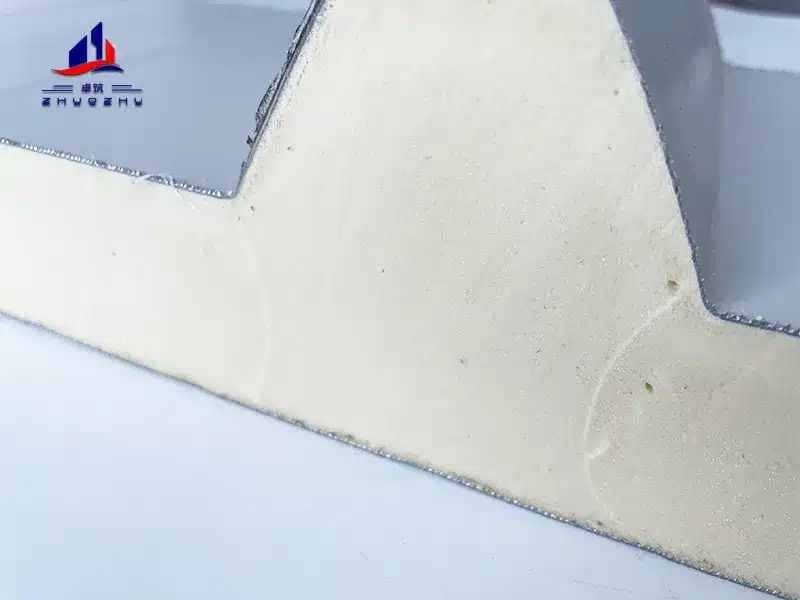
2.1 Polyisocyanurate (PIR) – The Premium Cellular Insulation
- Closed-Cell Ratio: 92-96% (industry premium range)
- Thermal Conductivity: 0.018 W/m·K – The industry’s lowest among widely available foam insulations
- Cellular Characteristics:
- Fine, uniform cell structure with reinforced cell walls
- Excellent dimensional stability with minimal long-term shrinkage
- Superior resistance to thermal cycling stress
- Performance Advantages:
- Optimal balance of thermal performance and fire resistance
- Minimal aging factor with stable long-term R-value
- Excellent moisture resistance (<1% water absorption by volume)
- High compressive strength (≥150 kPa)
Application Priority: Cold room panels, ultra-low temperature storage, and facilities where maximum thermal efficiency is paramount.
2.2 Polyurethane (PUR) – The Established Performance Standard
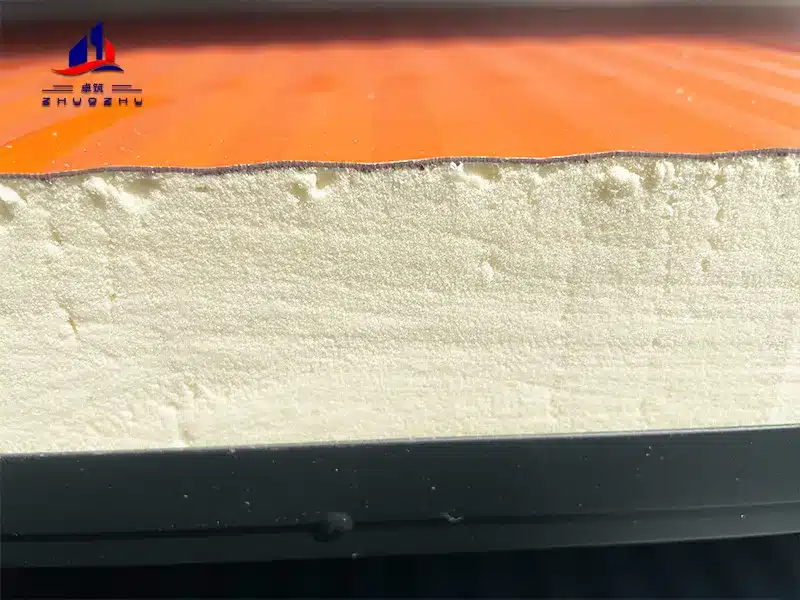
- Closed-Cell Ratio: 88-92% (standard commercial range)
- Thermal Conductivity: 0.022-0.024 W/m·K – Excellent thermal performance
- Cellular Characteristics:
- Slightly larger cell structure than PIR
- Good cell wall integrity in quality formulations
- Proven long-term performance in diverse applications
- Performance Profile:
- Reliable thermal efficiency for most industrial applications
- Good moisture resistance with proper vapor barriers
- Cost-effective solution for standard temperature requirements
- Established fire performance characteristics
Application Priority: General industrial buildings, moderate-temperature storage, and projects balancing performance with budget considerations.
2.3 The PIR vs. PUR Thermal Performance Reality
The 0.018 W/m·K versus 0.022-0.024 W/m·K difference represents a significant 18-22% improvement in thermal resistance for PIR over standard PUR. This translates directly to:
- Thinner walls achieving equivalent insulation values
- Lower energy costs for temperature-controlled facilities
- Reduced refrigeration system sizing and capital investment
- Improved sustainability through reduced operational energy consumption
2.4 Expanded Polystyrene (EPS) – The Bead-Based Alternative
- Structural Reality: Not a true homogeneous closed-cell foam
- Effective “Closed-Cell” Ratio: 40-60% due to inter-bead porosity
- Thermal Conductivity: 0.033-0.038 W/m·K – Significantly higher than PIR/PUR
- Critical Consideration: The inter-bead spaces create continuous pathways for moisture and air migration, requiring meticulous vapor barrier design in cold applications.

Part 3: Performance Implications in Real-World Applications
3.1 Thermal Efficiency & Longevity
Closed-Cell Content Directly Impacts:
- Initial R-Value: Higher closed-cell ratios trap more low-conductivity gas, yielding better immediate insulation performance
- Aging Characteristics: More complete cell walls slow the escape of blowing agents, maintaining R-value over decades
- Temperature Stability: Consistent cellular structure provides predictable performance across operational temperature ranges
Quantitative Impact Analysis:
A comparison of 100mm panels in a -20°C cold storage application:
- PIR Panel (95% closed-cell): U-value = 0.18 W/m²K, stable for 25+ years
- PUR Panel (90% closed-cell): U-value = 0.22 W/m²K, moderate aging expected
- EPS Panel (50% effective): U-value = 0.32 W/m²K, significant degradation with moisture exposure
3.2 Moisture Management in Critical Environments
The closed-cell ratio determines a panel’s inherent vapor resistance:
High Closed-Cell Materials (>90%):
- Act as intrinsic vapor retarders
- Minimize reliance on perfect field-applied vapor barriers
- Reduce condensation risk in cold room panel applications
- Maintain performance in high-humidity environments
Lower Closed-Cell Materials (<85%):
- Require flawless vapor barrier installation and maintenance
- Risk interstitial condensation if barrier integrity is compromised
- Potential for moisture accumulation and insulation degradation
3.3 Structural Contribution to Building Systems
| Structural Property | High Closed-Cell (>92%) | Moderate Closed-Cell (85-90%) |
|---|---|---|
| Compressive Strength | Excellent (cells resist deformation) | Good (adequate for most applications) |
| Dimensional Stability | Minimal shrinkage/swelling | Moderate movement potential |
| Fastener Retention | Superior holding power | Standard performance |
| Impact Resistance | Better energy absorption | Adequate for normal use |
Part 4: ZHUOZHU’s Manufacturing Excellence in Cellular Control
4.1 Achieving Premium Cellular Structure
Our manufacturing process incorporates several critical innovations:
- Precision Chemical Formulation: Optimized ratios of isocyanates and polyols for complete cell wall formation
- Controlled Expansion Technology: Regulated pressure and temperature profiles prevent cell wall rupture
- Advanced Curing Systems: Ensures complete cross-linking before panel handling
- Quality Monitoring: Real-time process control with batch verification testing
4.2 Verification and Certification
- Batch Testing: Every production lot undergoes closed-cell content analysis
- Thermal Performance Correlation: Direct measurement linking cellular structure to lambda values
- Third-Party Certification: Independent verification of claimed performance characteristics
- Long-Term Testing: Accelerated aging tests validating performance retention claims
Part 5: Selection Guidelines Based on Application Requirements
5.1 Applications Demanding Premium PIR (0.018 W/m·K, >92% Closed-Cell)
- Ultra-Low Temperature Facilities: < -25°C cold storage and blast freezers
- Pharmaceutical Grade Cleanrooms: Where temperature stability is critical
- High-Value Product Storage: Where energy costs dominate operational expenses
- Long-Lifecycle Buildings: 30+ year facilities where lifecycle cost matters more than initial investment
ZHUOZHU Recommendation: Our premium PIR sandwich panels with certified performance characteristics.
5.2 Applications Suitable for Quality PUR (0.022-0.024 W/m·K, 88-92% Closed-Cell)
- General Industrial Buildings: Warehouses and manufacturing facilities
- Moderate Temperature Storage: +2°C to -18°C range
- Cost-Sensitive Projects: Where budget constraints require optimization
- Non-Critical Applications: Where occasional temperature fluctuations are acceptable
ZHUOZHU Recommendation: Our standard PUR/PIR sandwich panels providing excellent value-performance balance.
5.3 When Other Factors Dominate Selection
- Fire-Rated Construction: Rock wool sandwich panels for non-combustible requirements
- Acoustic Priority Spaces: Where sound attenuation outweighs thermal considerations
- Temporary Structures: Short-duration installations where premium insulation isn’t justified
- Specialized Applications: Unique requirements dictating specific material choices
Conclusion: The Cellular Foundation of Insulation Performance
The closed-cell ratio serves as a fundamental quality indicator that predicts real-world insulation performance more reliably than many advertised specifications. The difference between PIR’s 0.018 W/m·K and PUR’s 0.022-0.024 W/m·K isn’t merely a laboratory measurement—it represents tangible differences in energy consumption, equipment sizing, and long-term facility performance.
For specifiers and building professionals, the implications are clear:
- For critical temperature control applications, insist on verified closed-cell content >92% and thermal conductivity ≤0.020 W/m·K
- Understand the total cost implications of insulation selection—premium materials often pay back through energy savings and reduced maintenance
- Request comprehensive documentation including independent test reports for both initial and aged performance
- Consider the complete system—panel performance depends on proper installation and integration with vapor barriers and structural systems
ZHUOZHU’s manufacturing philosophy recognizes that cellular structure determines performance destiny. Our commitment to achieving 92-96% closed-cell content in PIR cores isn’t a technical abstraction—it’s our guarantee that the insulation values we specify will be the values your facility experiences throughout its operational life. In the precise world of temperature-controlled construction, what happens at the microscopic level ultimately determines success at the facility level.
About the Author
Wald is the Chief Engineer at ZHUOZHU with specialized expertise in polymer science and building physics. His research focuses on the relationship between microscopic foam structures and macroscopic building performance, with particular emphasis on cold room panel applications and industrial insulation systems. Learn More About Us
