
Hello everyone, Wald here again. Over the past few weeks, while working on our ULC and CE EN13501 certifications, I’ve had many conversations with clients about fire performance requirements for sandwich panels. These discussions often circle around the same set of codes and letters—B-s1,d0, B-s2,d0, E60, EW60, EI60, E120, EW120, EI120—and I’ve noticed there is genuine confusion in the market about what these actually mean and, critically, how they relate to the panels you order.
So today, I want to break these down clearly. This is not just textbook theory; it is practical knowledge that directly affects how we quote, test, and supply your panels.
Part 1: Reaction to Fire — B-s1,d0 and B-s2,d0
These designations come from the European standard EN 13501-1, which classifies the reaction to fire of construction products. They tell you how a material behaves when exposed to fire—not for how long it resists fire, but what it contributes to the fire itself. The classification has three parts:
- The letter (B): This is the main class, ranging from A1 (non-combustible) down to F. Class B indicates a material with very limited contribution to fire, similar to what many regulations require for wall linings in escape routes. PIR sandwich panels can often achieve B when tested appropriately.
- The smoke index (s1 or s2): This measures smoke production. s1 means very limited smoke emission, s2 means limited but somewhat higher. In a real fire, smoke is often the greater killer, so an s1 rating is highly valued in enclosed or crowded spaces.
- The droplet index (d0): This indicates whether the material produces flaming droplets or particles during combustion. d0 means no flaming droplets within the test period. This is critical for safety because falling burning droplets can spread fire downwards and ignite secondary fires.
So, a classification of B-s1,d0 means: very limited fire contribution, very low smoke, and no burning droplets. B-s2,d0 allows slightly more smoke but still no burning droplets. Both are considered high-performance for organic foam-cored panels, and many European countries mandate B-s1,d0 or at least B-s2,d0 for building envelopes of certain building types.
Part 2: Fire Resistance — E, EW, and EI (with 60 or 120 minutes)
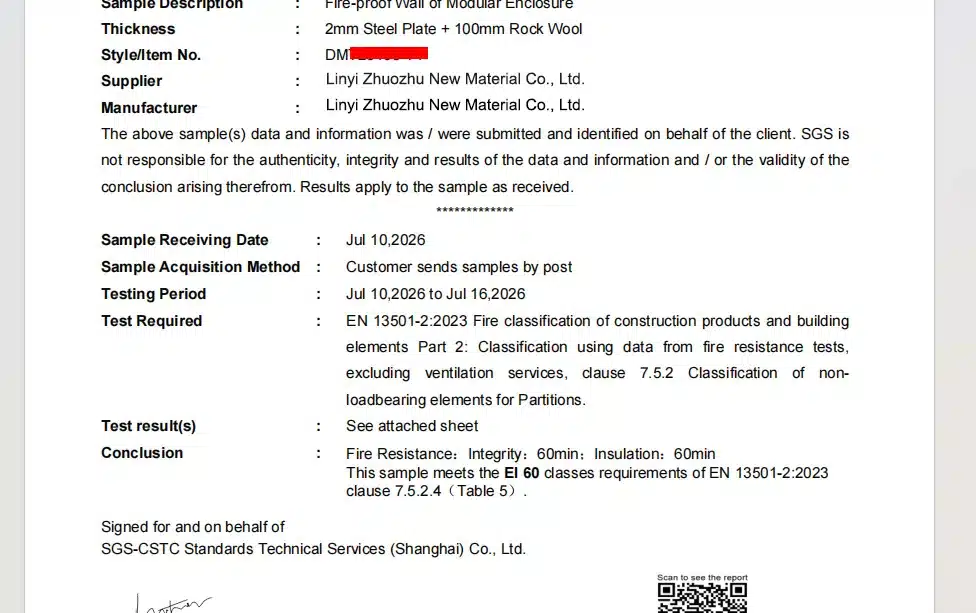
This is a completely different concept, defined in EN 13501-2. Fire resistance measures how long a complete element—a wall or a ceiling—can maintain its function under a standard fire test. The letters stand for:
- E (Integrity): The panel continues to stop flames and hot gases from passing through. No cracks or openings that allow fire to penetrate to the unexposed side.
- EW (Integrity and Radiation): In addition to integrity, the panel limits the heat radiation on the unexposed side to below a certain threshold, protecting people and materials nearby from being ignited by radiant heat alone.
- EI (Integrity and Insulation): The full standard. The panel maintains integrity and keeps the average temperature rise on the unexposed side below 140°C (and no single point above 180°C). This means the fire is contained, and the other side stays cool enough to prevent fire spread.
The number—60, 120, etc.—is the time in minutes that the element satisfies these criteria under a standard fire curve. So EI60 means a panel wall maintained both integrity and insulation for 60 minutes. EI120 is 120 minutes, often required for high-risk areas or structural compartmentation.
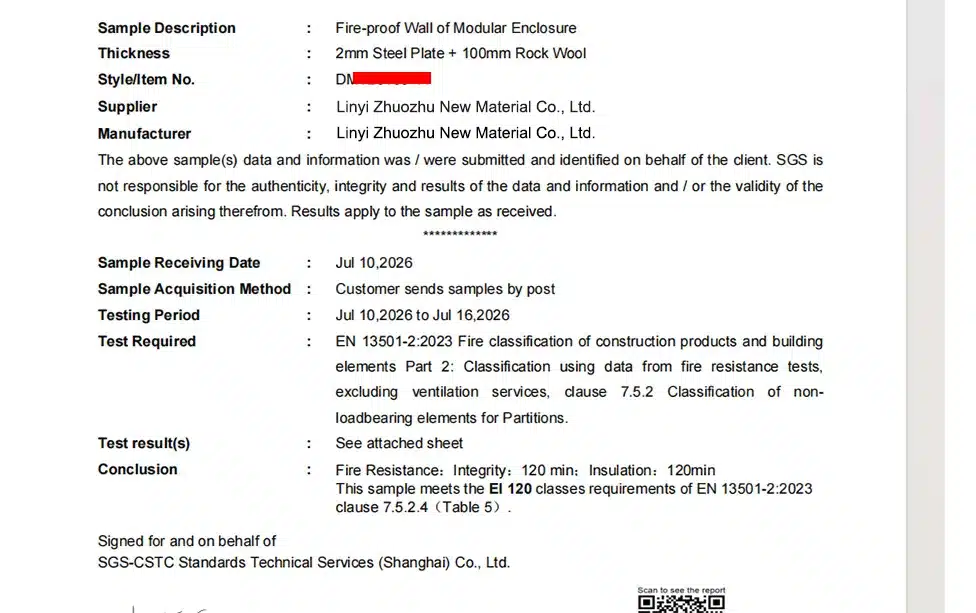
The Crucial Detail Nobody Tells You: Thickness Dependency
This is where I need to draw a very clear line, because it’s something I find many clients do not realize until we explain it. These fire ratings—whether reaction to fire or fire resistance—are thickness-specific.
What does that mean in practice? If a client asks for a 40mm PIR sandwich panel and needs a B-s1,d0 classification, we must test a 40mm PIR panel. The test report is valid only for 40mm thickness. It does not automatically cover a 30mm panel or a 50mm panel from the same production line, with the same facings, and the same core formulation.
Why? Because fire behavior changes with thickness. A thicker foam core can absorb more heat, char differently, or produce different smoke dynamics. The fire resistance period (EI) is even more obviously linked to the core thickness—a 100mm panel will almost certainly have a higher EI rating than a 50mm one. But no extrapolation is permitted under certification rules. Each thickness must stand on its own test evidence.
I’ve had conversations where a client says, “We need 80mm panels for our project, but we saw your test report for 100mm panels with B-s1,d0. That should be fine, right?” I have to tell them: unfortunately, no. If your specification requires a certified fire class for 80mm, we need to test 80mm. There is no shortcut.
The Real-World Consequence: Cost and Lead Time
This brings us to a practical reality. If a client requires a specific fire certification that we do not already hold in their exact panel thickness, we must commission a fire test for that specific configuration. Fire testing is expensive, it requires full-size samples to be produced and shipped to an accredited laboratory, and it takes time.
Because of this, when such certifications are mandated by local building codes, the cost of the project rises. This is not a hidden margin on our side—it’s the direct cost of third-party testing. We are transparent about this from the first conversation. We ask clients to specify their required fire class and the exact panel thickness. Then we can tell them whether we already have a valid report on file, or whether a new test cycle is necessary, along with the associated cost and timeline.
We at ZHUOZHUO are committed to meeting our clients’ compliance needs, and we are actively expanding our library of fire test reports across multiple thicknesses and facing combinations. But we also believe in education: no one should be surprised by a cost they didn’t expect. Understanding that B-s1,d0 on a 50mm panel is not the same as B-s1,d0 on an 80mm panel is a key part of that education.
If your next project demands a specific fire rating, reach out early. Tell us the thickness and the required standard. I’m Wald, and together with our technical team, we’ll map out the most honest and efficient path to certified, compliant panels—with no surprises.
