
Introduction: The Core Decision in Building Envelope Systems
In modern architectural design and construction, selecting the correct insulated sandwich panel is crucial not only for energy efficiency but also directly impacts a building’s fire safety, long-term durability, and total cost of ownership. When faced with the choice between stone wool sandwich panels and PIR sandwich panels, decision-makers often grapple with the dilemma of balancing “fire safety” against “thermal performance.” This article provides a clear comparative guide from the perspectives of materials science, building physics, and practical application, helping you make the most informed strategic choice based on your project’s specific needs. For projects requiring exceptional fire ratings, partnering with reliable stone wool sandwich panel manufacturers or mineral wool sandwich panel suppliers is essential, while those prioritizing ultimate insulation might look to PIR sandwich panel manufacturers.

Chapter 1: Material Essence and Core Properties Comparison
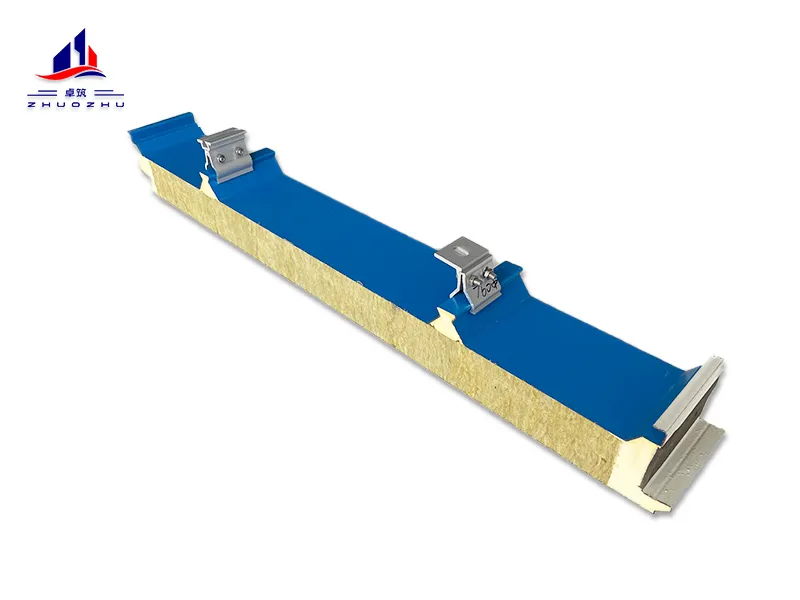
Stone Wool/Mineral Wool Sandwich Panels: The Inorganic Guardian with Fire Safety at Its Core
Material Composition:
- Core Base Material: Natural ores like basalt and slag, fiberized after high-temperature melting.
- Structural characteristics: Three-dimensional mesh fiber structure, open-cell construction.
- Density Range: Typically 80-150 kg/m³, adjustable based on application.
- Key Performance Label: Class A Non-combustible Material (highest grade), making it a premier choice among fire rated sandwich panel options.

PIR (Polyisocyanurate) Sandwich Panels: The Organic Elite Driven by Efficiency
Material Composition:
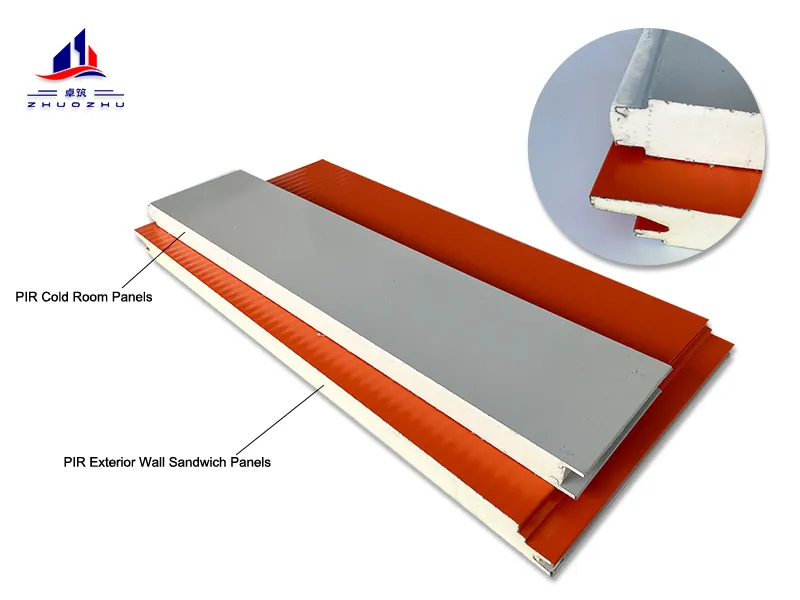
- Chemical Basis: Polyisocyanurate, formed by the reaction of isocyanate and polyester polyol.
- Structural characteristics: Uniform, fine, closed-cell honeycomb structure.
- Density Range: 35-45 kg/m³, with an excellent strength-to-weight ratio.
- Key Performance Label: Class B1 Flame-Retardant Material (self-extinguishing), offering superior insulation with a thermal conductivity as low as 0.022-0.026 W/(m·K). For large-scale projects, sourcing from wholesale PIR sandwich panel suppliers or seeking customized PIR sandwich panel solutions can optimize cost and performance.
Chapter 2: In-Depth Performance Comparison Across Five Dimensions
1. Fire Safety Performance: The Fundamental Difference at the Safety Red Line
The Absolute Advantage of Rockwool Sandwich Panels:
- Non-combustibility Test: Maintains structural integrity at 1000°C, without producing toxic smoke.
- Fire Compartmentation: Ideal for firewalls, escape routes, and core tubes in high-rise buildings.
- Insurance Advantage: Often qualifies for more favorable building insurance premiums.
The Practical Fire Protection of PIR Panels:
- Flame Retardant Mechanism: Chars rapidly on the surface when burning, forming an insulating layer that prevents flame spread.
- Smoke Control: Modern formulations have significantly reduced smoke toxicity.
Decision Point: If the project has mandatory Class A fire requirements (e.g., public buildings, hazardous material warehouses), mineral wool sandwich panels are the only choice. For general industrial/commercial buildings, PIR’s Class B1 rating usually meets code and offers better cost-effectiveness. Bulk rock wool sandwich panel purchases are common for large projects with such safety mandates.

2. Thermal Insulation and Energy Efficiency: Key to Long-Term Operational Costs
Direct Thermal Performance Comparison:
| Performance Parameter | Mineral Wool Sandwich Panel (100mm) | PIR Sandwich Panel (100mm) | Performance Difference |
|---|---|---|---|
| Thermal Conductivity (λ) | 0.038 W/(m·K) | 0.024 W/(m·K) | PIR is 37% better |
| Thermal Resistance (R) | 2.63 (m²·K)/W | 4.17 (m²·K)/W | PIR is 58% better |
| Thickness for Same R-value | 100mm | 63mm | PIR saves 37% thickness |
Long-Term Energy Impact Analysis:
- PIR Sandwich Panels: For the same insulation requirement, thinner panels can be used, increasing usable floor area, or significantly reducing heating/cooling energy consumption (typically 20%-30% more energy-efficient than a rock wool panel solution).
- Stone Wool Sandwich Panels: Require thicker walls for equivalent insulation but have better thermal inertia, providing superior buffering against temperature fluctuations.
3. Application Scenario Strategic Selection Guide
Scenarios Where Stone Wool/Rockwool Sandwich Panels Should Be Prioritized:
- Locations with Mandatory Fire Codes:
- Public buildings (schools, hospitals, theaters, shopping malls).
- High-rise buildings.
- Facilities for hazardous material storage/production. For these, working with experienced stone wool sandwich panel suppliers is crucial.
Scenarios Where PIR Sandwich Panels Should Be Prioritized:
- Locations with Extremely High Insulation Demands:
Cold roomsystems (refrigerated/frozen storage, pharmaceutical warehousing).- Passive House, ultra-low energy buildings.
- Severe cold or hot climate zones. These often benefit from advanced PIR sandwich panel technology.
- Space- or Weight-Sensitive Projects:
- Building renovation and retrofitting projects.
- Long-span lightweight structures.
- Modular prefabricated buildings.

Innovative Solution: Composite Application Strategy
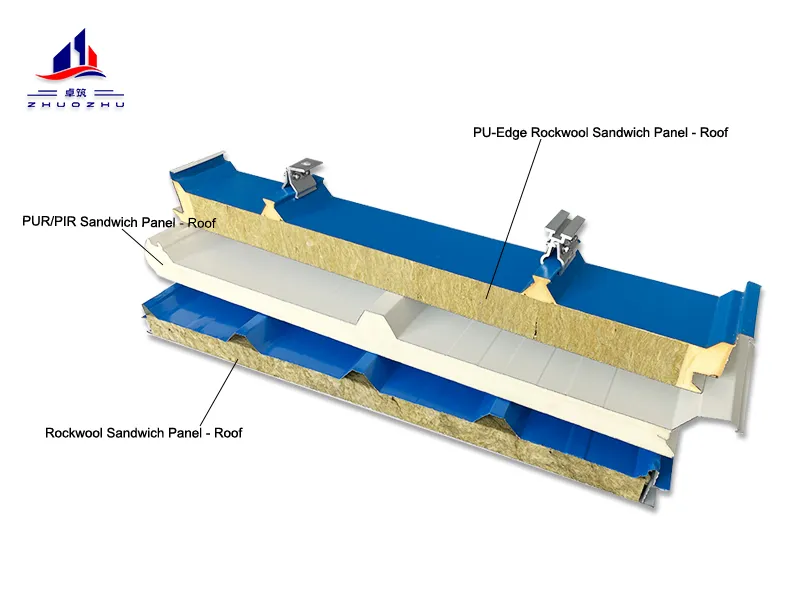
For complex projects, a hybrid use strategy can be employed, which ZHUOZHU has successfully implemented in several large-scale industrial projects:
- Exterior Walls: Use PIR sandwich panels for optimal insulation.
- Internal Fire Partition Walls: Use rockwool sandwich panels to ensure fire safety.
- Roof: Choose PIR or mineral wool based on load and insulation requirements.
This approach balances safety, performance, and economy. Choosing an ODM mineral wool sandwich panel or customized sandwich panel provider can facilitate such bespoke solutions.
Chapter 3: ZHUOZHU’s Professional Product Lines and Support
As a manufacturer supplying both high-performance stone wool sandwich panels and top-tier PIR sandwich panels, ZHUOZHU‘s advantage lies in providing unbiased professional advice and complete solutions.
Features of Our Rockwool Sandwich Panel Series:
- Fire Safety Guarantee: Full product line with Class A fire certification.
- Density Options: Various specifications from 80kg/m³ to 150kg/m³.
- Surface Finish: Can be paired with various metal facings for aesthetic needs. We are a trusted pure rock wool panel supplier.
Advantages of Our PIR Sandwich Panel Series:
- Efficiency Benchmark: Uses premium raw materials to ensure λ-value ≤ 0.024W/(m·K).
- System Compatibility: Optimized for systems like cold rooms and cleanrooms.
- Durability Promise: Offers performance warranties of up to 10 years. We provide quality PIR sandwich panel options for demanding applications.
Conclusion: Decision-Making Based on Science, Not Bias
Choosing between mineral wool and PIR is not a simple question of “good vs. bad,” but an optimization problem based on the specific constraints of the project.
Follow this decision-making process:
- Check Mandatory Requirements: First, confirm local building codes and the project’s own mandatory fire rating requirements.
- Define Core Objectives: Determine if the project’s primary goal is ultimate energy savings, cost control, or absolute safety.
- Calculate Full Lifecycle Cost: Consider not just material unit price, but total costs including installation, space, and energy consumption.
- Consult Professional Partners: Have in-depth discussions with suppliers like
ZHUOZHUwho are proficient in both materials.
Through scientific analysis and professional support, you can find the optimal balance between “fire safety” and “thermal efficiency,” creating an exceptional building envelope system that is both safe and economical for your project.
