
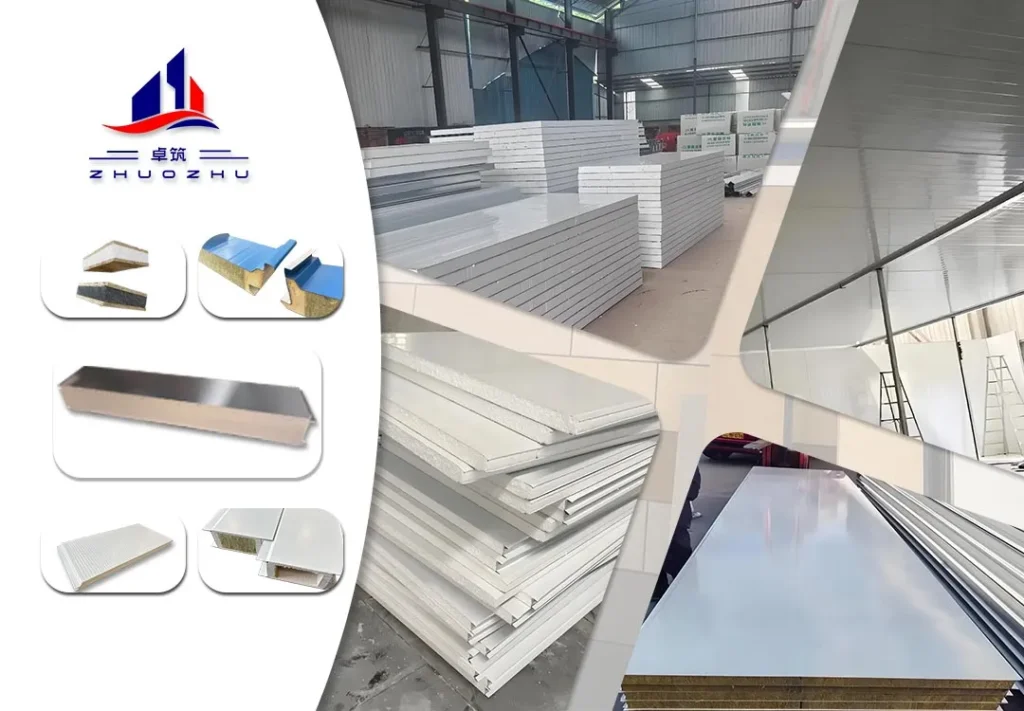
Designing an efficient and reliable cold storage facility goes beyond just keeping things cold. It’s about creating a robust, energy-efficient envelope that controls temperature, manages moisture, and lasts for decades. The choice of sandwich panels for walls and roofs is the most critical decision you’ll make, impacting everything from upfront cost to lifelong operational expenses. This guide, from the perspective of a leading manufacturer, cuts through industry jargon and common misconceptions. We’ll explain why rock wool sandwich panels are the standard for walls, why PIR panels dominate modern roofs, and how to specify them correctly to avoid hidden pitfalls like thermal bridges and condensation.
The Foundation – Understanding Your Cold Room Needs
Before selecting panels, define your project’s core requirements:
- Temperature Range: Chilled storage (+2°C to +8°C) vs. freezer warehouses (-18°C to -25°C or lower).
- Fire Safety Regulations: Local building codes may dictate specific fire rating requirements (e.g., Class A, B-s1,d0).
- Hygiene & Cleanability: Essential for food-grade cold rooms and cleanroom panels in processing areas.
- Budget & Lifespan: Balancing initial investment with long-term energy savings and maintenance costs.
The Industry-Standard Combination: Rockwool Walls & PIR Roof
Why Rockwool (Stone Wool) for Walls?
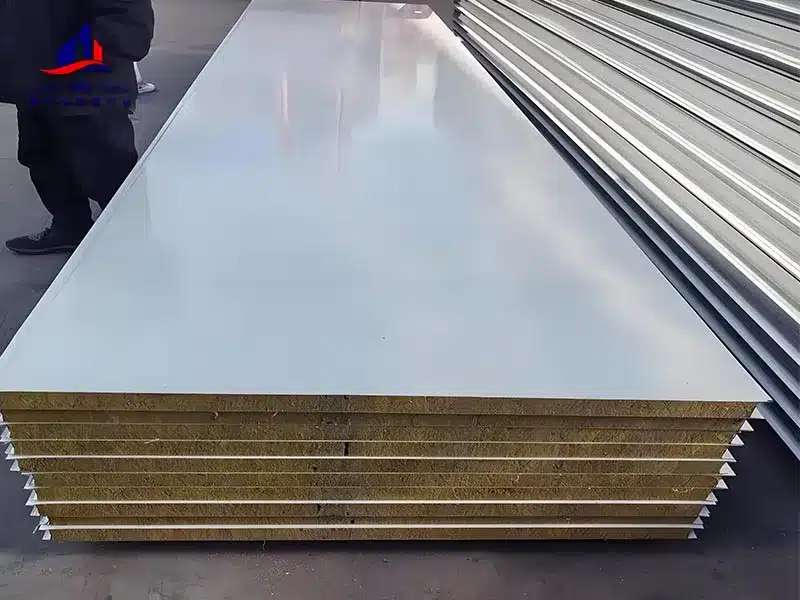
For the vertical walls of a steel structure factory or cold store, rock wool sandwich panels are the predominant, cost-effective choice. Here’s why:
- Cost Efficiency: They typically offer a lower price per square meter compared to equivalent-thickness PIR panels, providing significant savings on large wall areas.
- Superior Fire Performance: Rockwool is inherently non-combustible (A1 fire rated). This is a critical safety feature for building walls, which are often subject to stricter fire compartmentalization codes.
- Excellent Acoustic Insulation: They provide better sound damping than foam cores, reducing noise transmission.
Why PIR for Roofs?
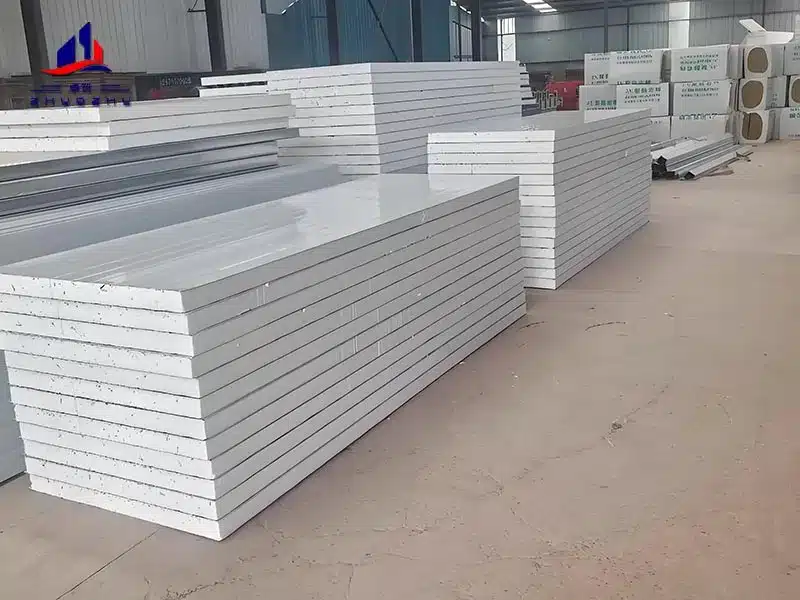
The roof of a cold room faces different challenges: spanning longer distances, bearing potential snow loads, and resisting wind uplift. Here, PIR sandwich panels are the performance champion.
- Higher Mechanical Strength: PIR foam cores, combined with thicker metal facings, provide superior bending resistance for wide roof spans without intermediate supports, making them ideal for integration with C/Z purlins.
- Optimal Long-Term Thermal Efficiency: PIR has one of the lowest and most stable thermal conductivity values over time. This long-term R-value is crucial for the ceiling, where heat gain/loss is significant, directly impacting energy bills.
- Lightweight & Durable: Offers an excellent strength-to-weight ratio, reducing the load on the steel structure.
- A Critical Industry Clarification: When suppliers quote “polyurethane (PU/PUR) roof panels,” they are almost invariably referring to PIR-core panels. Due to PIR’s superior cost-performance ratio, it has effectively replaced traditional PUR in modern manufacturing. While the terms are used interchangeably, the core material has evolved. At ZHUOZHU, we specify PIR clearly in our datasheets for transparency.
Part 3: Beyond the Core – Critical Specifications & System Integration
Choosing the right core is just the start. These details determine success or failure:
- Thickness Calculation: Wall and roof panel thickness (e.g., 100mm, 150mm) is determined by your required U-value and internal temperature. Thicker panels for lower temperatures.
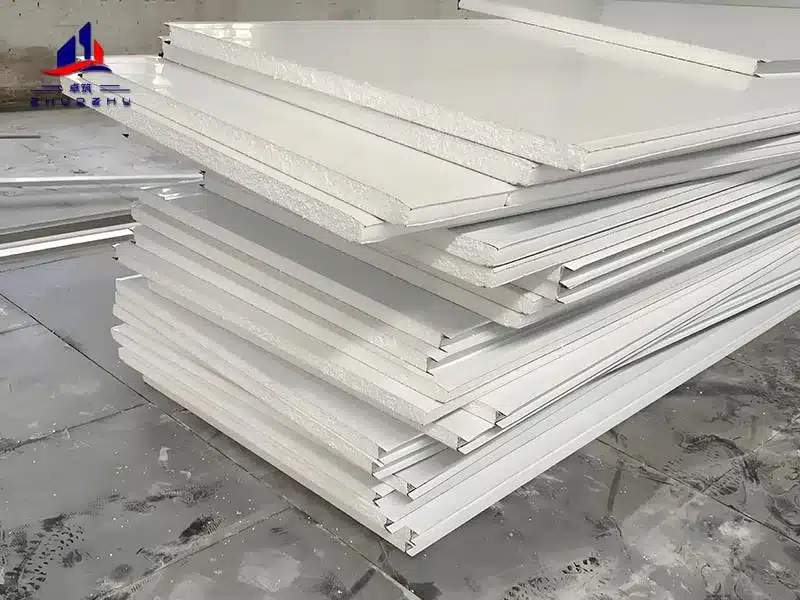
- Joint Design: For a true thermal break, specify panels with tongue-and-groove or secret-fix joints and PU edge sealing. This is the best defense against cold bridging and condensation at the seams.
- Facings: Choose the appropriate exterior metal coating (PE, PVDF, etc.) for corrosion resistance based on the environment.
- Integration with Daylighting: To improve internal brightness and reduce lighting costs, FRP Roof Panels (Fiberglass Reinforced Polyester sheets) can be integrated into the roof panel layout, typically at a ratio of 5-10%.
- Vapor Barrier Continuity: Ensure the panel joints and connections to doors, floors, and corners are designed to maintain a continuous vapor barrier, preventing moisture ingress and ice buildup.
Part 4: Common Pitfalls & How ZHUOZHU Helps You Avoid Them
- Pitfall 1: Using the Wrong Core for the Application. Using EPS panels in a low-temperature freezer or specifying PIR where a non-combustible wall is code-mandated.
- Our Solution: We provide clear application guides and technical consultation based on your specific project parameters.
- Pitfall 2: Neglecting the Joint. Standard lap joints can become major thermal bridges and leak points.
- Our Solution: We specialize in cold room panels and cleanroom panels with advanced, thermally broken joint systems.
- Pitfall 3: Focusing Only on Initial Price. The cheapest panel may have higher thermal conductivity, leading to massive energy waste over 10+ years.
- Our Solution: We offer data-driven comparisons showing the total cost of ownership, where a higher-performing PIR roof often saves more in energy than its initial premium cost.
About the Author
Wald is the Chief Engineer at ZHUOZHU, holding a Bachelor’s degree in Building Materials Engineering and over 8 years of specialized experience in insulation and refrigeration panel systems. He has been deeply involved in numerous multinational cold chain logistics and industrial plant projects, committed to providing clients with wall and roof systems that meet stringent energy efficiency and safety standards. Learn More About Us
