
Selecting the correct sandwich panel specifications is the cornerstone of ensuring building performance, construction efficiency, and project economy. As a leading global building panel manufacturer and exporter, ZHUOZHU provides comprehensive, precise specification guidance based on deep technical expertise and production experience. This article provides an in-depth analysis of the six core specification elements that determine panel performance—Size, Thickness, Core Material, Performance, Joint Profile, and Application—and reveals how they are interconnected, helping you make the most informed decision for your next project.
1. Size Specifications: The Foundation for Installation Efficiency and Architectural Aesthetics
Size specifications for sandwich panels primarily refer to their width, length, and thickness (thickness will be discussed separately in the next section). They directly impact installation speed, number of joints, material waste, and the final linear aesthetic of the building facade.
1.1 Standard Width (Cover Width)
- Common Specifications: Typically 950mm, 1000mm, 1150mm, 1200mm effective cover width.
- Selection Logic:
- Efficiency & Cost: Wider panels (e.g., 1200mm) mean fewer longitudinal joints, faster installation, and fewer sealing lines, thereby improving construction efficiency and reducing long-term maintenance risks (e.g., leaks at joints).
- Architectural Effect: Width also affects the visual proportion of facade segmentation. Modern minimalist architecture often prefers wider panels to create a clean, bold facade line.
- Structural Consideration: Panel width must match purlin spacing (span). For the same thickness, wider panels may require closer purlin support to ensure stiffness.

1.2 Custom Length
- Production Principle: Sandwich panels can usually be produced to custom lengths as per project requirements, with maximum lengths up to 12 meters or more, depending on factory equipment and transportation conditions.
- Core Advantages:
- Reduced Transverse Joints: Custom lengths allow for installation without transverse joints in the drainage direction of roofs or walls, greatly improving waterproof reliability and aesthetics.
- Precise Cutting, Less Waste: Customizing lengths based on building modules minimizes on-site cutting and material waste.
- ZHUOZHU Service: We offer precise custom cutting services and optimized packaging solutions to ensure the safety of extra-long panels during transportation.
2. Thickness Specifications: The Key to Balancing Insulation, Structure, and Cost
Thickness is one of the core specifications of a sandwich panel, directly determining its thermal insulation performance and structural load-bearing capacity.

2.1 Standard Thickness Series
- Economical / Partition Use: 25mm, 30mm, 40mm — Commonly used for interior partitions and areas with minimal insulation requirements.
- General Insulation Type: 50mm, 75mm — The most widely used specifications, suitable for walls and roofs of most industrial and commercial buildings in temperate climates, representing the balance point of performance and cost.
- High Insulation / Special Application Type: 100mm, 120mm, 150mm, 200mm — Used for cold room(cold room panels), buildings in severely cold regions, or projects with extremely high energy efficiency requirements. For example, a -25°C freezer warehouse typically requires PIR or rock wool sandwich panels with a thickness of 150mm or above.
- Complete Analysis of 50mm Sandwich Panel Applications: Finding the Optimal Balance Between Thickness and Performance
- When to Choose 100mm PIR Sandwich Panels? Unveiling the Five Core Application Scenarios for High-Specification Insulated Panels
2.2 Correlation Between Thickness and Performance
- Thermal Performance (R-value/U-value): With the same core material, thickness is roughly proportional to thermal resistance (R-value). Doubling the thickness roughly doubles the R-value, significantly improving insulation.
- Structural Strength: Increasing thickness greatly enhances the panel’s section modulus, thereby improving its bending stiffness. This means that under the same load, thicker panels can allow for larger purlin spacing (span), or exhibit less deflection over the same span, ensuring roof flatness.
- Economy: Thickness is a major component of material cost. Selecting thickness requires a life-cycle cost analysis: initial investment vs. long-term operational energy savings.
3. Core Material Specifications: The Core Defining the Panel’s Essential Performance
The core material is the “heart” of the sandwich panel, determining its primary insulation, fire resistance, and physical properties.
3.1 Three Mainstream Core Material Systems
- PIR/PUR (Polyisocyanurate / Polyurethane)
- Performance Label: Top-tier insulation efficiency, good fire resistance (Class B1), high strength-to-weight ratio, excellent dimensional stability.
- Density Range: Typically 38-45 kg/m³. ZHUOZHU uses high-density formulations to ensure core uniformity and no risk of shrinkage.
- Thermal Conductivity (λ-value): Extremely low, reaching 0.022 – 0.024 W/(m·K), the preferred choice for high-efficiency buildings.
- Rock Wool
- Performance Label: Class A non-combustible fire resistance, excellent sound insulation, good thermal insulation, high-temperature stability.
- Density Range: Wall panels typically 100-120 kg/m³, roof panels 140-160 kg/m³ to provide sufficient compressive strength.
- Thermal Conductivity (λ-value): Approximately 0.036 – 0.042 W/(m·K). Its core value lies in fire safety, making it a mandatory or preferred material for firewalls, densely populated places, and high-risk industrial areas.
- EPS (Expanded Polystyrene)
- Performance Label: High cost-effectiveness, ultra-lightweight, moisture-resistant, easy to process.
- Density Range: Commonly 12 kg/m³, 16 kg/m³, 20 kg/m³. Higher density slightly improves compressive strength and insulation.
- Thermal Conductivity (λ-value): Approximately 0.035 – 0.040 W/(m·K). An economical choice for budget-sensitive projects like ordinary factories and warehouses where Class B2 fire rating is acceptable.
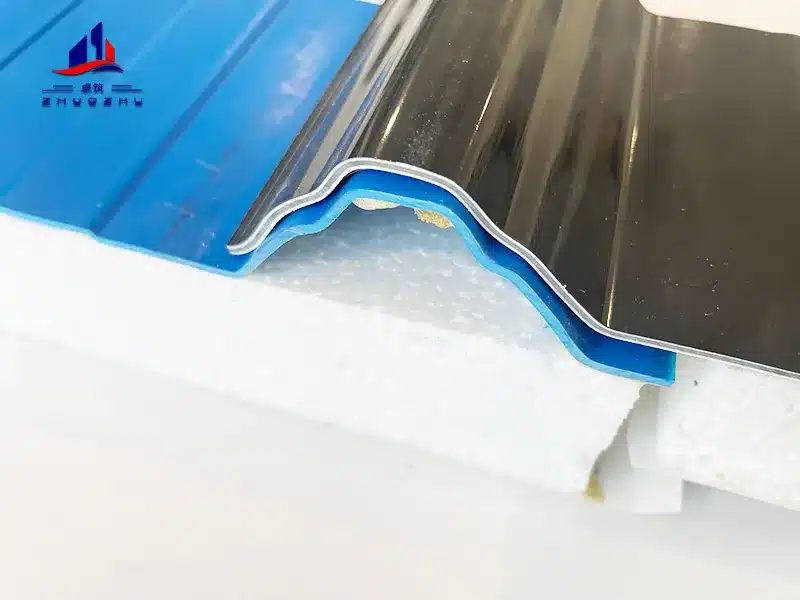
- Emerging Choice: PVC-faced EPS Core Panel
- Special Value: The facing uses corrosion-resistant PVC roof sheet, with an EPS core. Specifically designed for roofs in chemical, coastal, and other corrosive environments or where cost control is critical, offering a corrosion-resistant alternative to metal facings.
3.2 Synergistic Selection of Core Material and Thickness
- To achieve the same target insulation value (R-value), different core materials require different thicknesses: PIR is thinnest, rock wool is next, EPS is thickest.
- For example, to achieve a thermal resistance of R=5.0 (m²·K/W), approximately requires:
- PIR panel thickness: ~100mm
- Rock wool panel thickness: ~160mm
- EPS panel thickness: ~180mm
- (Note: This is an estimate. Exact values require calculation based on specific product density and thermal conductivity.)
4. Performance Specifications: The Promise of Quantifiable Data
Performance specifications are the result of the combined action of the core material, thickness, and facing, providing the direct basis for design calculations.

- Thermal Performance
- Thermal Conductivity (λ-value): Inherent property of the core material. The lower the value, the better the insulation.
- Thermal Resistance (R-value): R = Thickness(m) / λ. This is the direct indicator for evaluating panel insulation capability.
- Thermal Transmittance (U-value): The heat transfer performance of the entire wall or roof system, including the influence of panels, joints, purlins, etc. A low U-value is key to building energy efficiency.
- Structural Performance
- Bending Load Capacity: The maximum load (kPa) a unit width panel can withstand, directly related to core strength, thickness, and facing thickness.
- Allowable Span: The maximum purlin spacing under different loads (wind, snow, construction). ZHUOZHU provides detailed span-load tables for each product.
- Fire Performance
- Depending on the core material, different classes such as Class A (rock wool), Class B1 (PIR), Class B2 (EPS) are achieved, which must comply with the building fire codes of the project location.
- Acoustic Performance
- Primarily measured by Weighted Sound Reduction Index (Rw). Rock wool sandwich panels typically have better sound insulation than foam cores due to their porous fibrous structure.
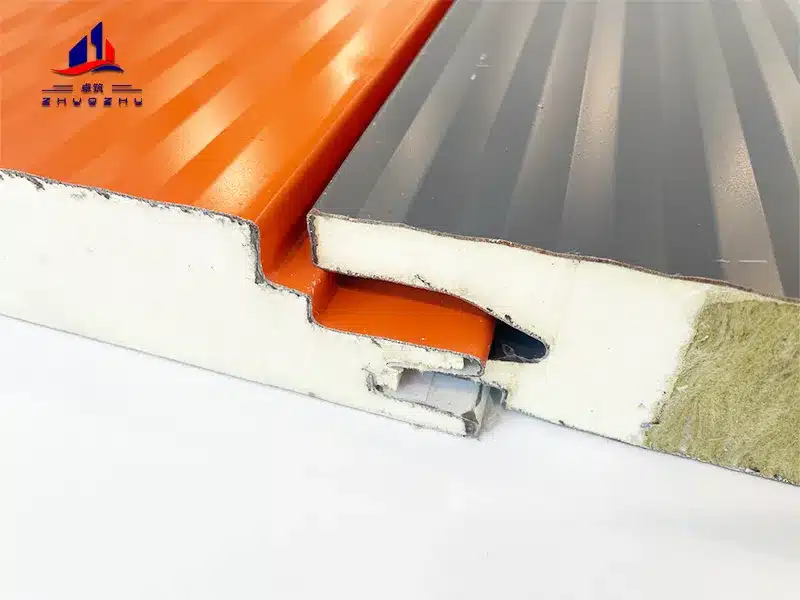
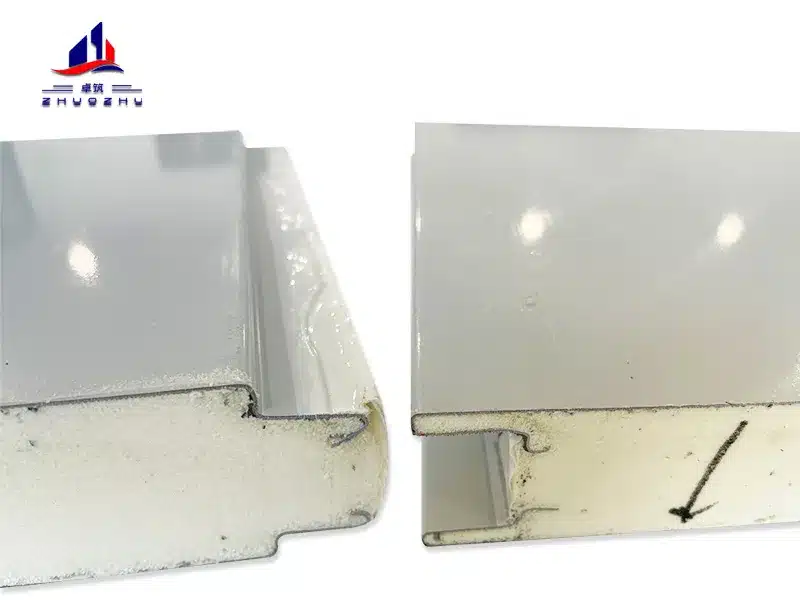
5. Joint Profile Specifications: The Details Ensuring Airtightness, Watertightness, and Integrity
The joint profile is the key connection between panels, and its design determines the long-term airtightness, watertightness, and wind resistance of the envelope system.
- Main Joint Types
- Concealed Clip System: Fixings are hidden, creating a clean facade appearance. Connected via a professional clipping action, offering optimal airtight and waterproof performance, making it the preferred choice for high-end commercial projects and energy-efficient buildings.
- Through-Fastened System: Uses screws that penetrate directly through the panel face for fixing. Installation is fast and cost is lower, but screw holes are potential cold bridges and leakage points, requiring high-quality sealing washers.
- Standing Seam System: Primarily used for roofs, panels are connected into a whole through on-site mechanical seaming. Offers excellent waterproof performance, allows for thermal expansion/contraction, and is suitable for large-span, sloping roofs, and harsh climate regions.
- Correlation Between Joint and Performance
- Cold Bridge Prevention: Concealed systems are superior to through-fastened systems.
- Wind Resistance & Negative Pressure Resistance: Standing seam and well-designed concealed systems can withstand higher wind loads.
- Installation Speed: Through-fastened is the fastest; concealed and standing seam systems require more training but offer higher long-term benefits.
6. Application Specifications: The Ultimate Guide for Specification Selection
The ultimate purpose of all specification parameters is to meet the needs of a specific building’s application. Below are examples of typical specification combinations based on application:
| Building Application | Recommended Core | Typical Thickness | Key Performance Focus | Recommended Joint |
|---|---|---|---|---|
| High-Standard Cold Chain Warehouses | PIR / Rock Wool | 100mm – 200mm | Ultimate Insulation (low U-value), Cold Bridge Prevention, Airtightness | Specialized cold room panel tight joint |
| Chemical Plants/Coastal Warehouses | Rock Wool / PVC-EPS | 75mm – 100mm | Fire Resistance (Class A) or Corrosion Resistance, Structural Strength | Anti-corrosion coating, Concealed joint |
| Large Logistics Warehouses | PIR / EPS | 50mm – 75mm | Cost-effectiveness, Large Span, Fast Installation | Through-fastened or Concealed |
| Commercial Offices/Hospitals | Rock Wool / PIR | 50mm – 100mm | Fire Safety (Class A/B1), Flat Appearance, Sound Insulation | Concealed Clip System |
| Industrial Plant Firewalls | Rock Wool | 75mm – 120mm | Class A Fire Resistance Duration (2h, 3h), Integrity | Specialized Fire-rated Detail Design |
| Lightweight Temporary Buildings | EPS | 25mm – 50mm | Ultra-lightweight, Low Cost, Easy Dismantling | Simple Through-fastened Connection |
ZHUOZHU’s Systematic Specification Service
Choosing ZHUOZHU means gaining not just a product catalog, but a complete specification optimization solution:
- Technical Consultation: Our engineers will recommend the optimal combination of size, thickness, core material, and joint profile based on your project location, application, codes, and budget.
- Performance Verification: We provide third-party test reports based on international standards (e.g., EN 14509, GB/T 23932), offering reliable data for design.
- Detail Design: Provide construction detail drawings including all node details, ensuring specifications are correctly implemented on-site.
- Global Supply Assurance: No matter how special the specifications, we can produce them stably from our modern factory in China and deliver them on time through efficient export channels.
Specifications are the intersection of science and engineering. Precise specification selection is half the success of a building. Let ZHUOZHU be your trusted specification partner in constructing efficient, safe, and economically excellent buildings.
About the Author
The systematic organization of this article stems from the specification application database and problem-solving experience accumulated by Wald, Chief Engineer at ZHUOZHU, and his team while serving thousands of global projects. Wald holds a Bachelor’s degree in Building Materials Engineering. He consistently maintains: “Correct specifications are not a pile of data, but a deep understanding and precise translation of building needs, environmental constraints, and long-term value.”
Get your project specification optimization plan: Contact Us
Explore our product matrix: Core Product Pages
